

Incorporating gaming into ZSR classes or any instructional setting is not a new concept or occurrence. Studies have produced substantial evidence supporting gamification into classroom environments as means to impact learning and skill acquisition. What IS new are two activities facilitated this month in LIB credit-bearing courses:
- Search&Destroy in LIB100: Academic Research and Information Issues
- Building the Evidence Hierarchy in LIB290: Critical Appraisal in Biomedical Literature
Search&Destroy in Shabrina’s LIB100
Search&Destroy is a multiplayer card game that supports database search skill development. The primary aim is to keep your hand (or search) ALIVE by carefully selecting keywords and modifiers in order to maintain results in a library database. Librarians Mari Kermit-Canfield and Gary Maixner developed the original Search&Destroy in 2017 then created a biomedical version in 2025. The RIO and DISC teams shared a friendly round of each version at their annual retreat in August to prepare for student gaming.
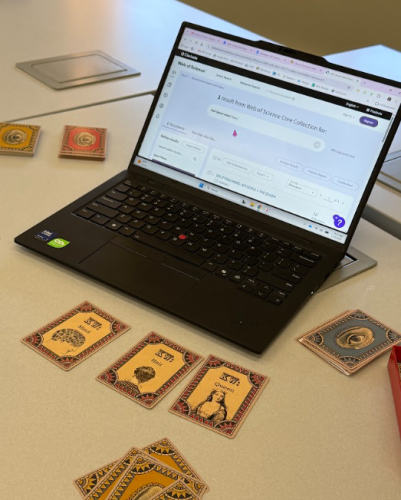
This was the perfect introduction to Boolean operators and database searching for my students. The game helped build rapport around the topic and gave students an opportunity to see how database searching works in real time before jumping into the lesson. Gameplay includes prompts that challenge students to add or remove Boolean operators like AND and OR, as well as combine seemingly unrelated terms like neurology and climate change – all to help students see how small changes to their search terms and the use of Boolean operators can impact results. Once gameplay was complete, we were able to transition right into my lesson on semantic and natural language searching versus lexical and keyword searching. It created a great foundation for the lesson and gave students a hands-on example to connect to the concepts we discussed afterward.
Building the Evidence Hierarchy in Colleen’s LIB290
Critical Appraisal in Biomedical Literature (or CABL) has been taught for two semesters and will continue to be offered to health science majors or any student with an interest in taking a deep dive into the methodological rigor of medical research. In the first three weeks of the course, students examine various study designs according to the Evidence Hierarchy(EH), a structural approach to ranking medical research formats based on their methodological rigor. Teaching based on the EH can be rather bland, however, without embedding some type of interaction. In comes the activity, Building the Evidence Hierarchy!
The activity was designed by Colleen over the summer with a combination of materials found at home and purchased using the ZSR supplies budget – thanks Kristen Morgan! Students build the hierarchy in two rounds. Round One focuses on structure; Round Two focuses on context. For instance, Round One builds the actual pyramid-style structure with Systematic Reviews at the top and Editorials and Opinion papers at the bottom. Round Two pushes students to consider study design and categorization where Randomized Controlled Trials take an “experimental” approach whereas Case-Controlled Studies are “observational” but both contain “unfiltered” evidence. 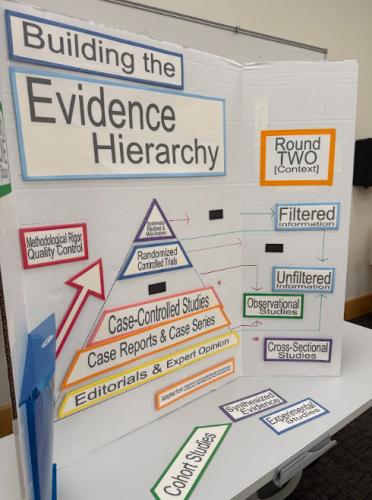
This pilot activity was not without flaws. Big thanks to this semester’s LIB290 students for helping me work out some initial kinks. However, it’s on its way to becoming a featured activity in future sections of CABL as well as LIB220 Science Research Sources and Strategies – both being offered in the spring.
Fun in Store with more Games
At least two other options for games are on the horizon for the Spring. PICO de Gallo, “a mild game to help you dip into clinical questions and search strategies” according to game designer and Clinical Engagement Librarian Raven Hill, is a fun and foody game centered around the PICO research question framework (Population, Intervention, Comparison, Outcome). Trust Issues is another product of Wunderkind Games, the same folks who brought us Search&Destroy. This one is designed to enhance instruction on the CRAAP test and increase engagement when discussing authority in research sources.
These fun options are just the start of how LIB course instructors are using and creating interactive ways to achieve learning objectives. Play on!
4 Comments on ‘Gaming in ZSR Library Credit-Bearing Courses’
This is one of those moments that makes me miss being a student. Learning Boolean logic and having fun at the same time is a win-win situation!
How fun to read about your incorporating fun into the lessons!
So fun and exciting for the students! I know they’ll love it !
This game is so fun to play! I’m so glad our students are getting to benefit from this fun way to learn! 🙂