
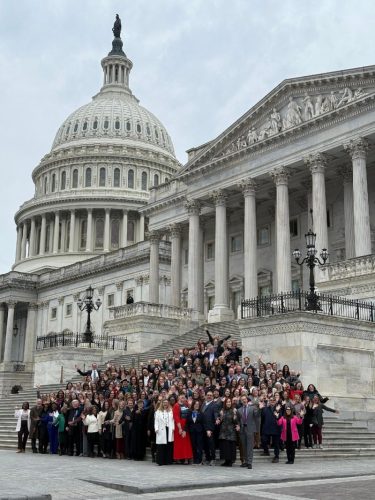
Last week I had the incredible privilege to share stories from North Carolina’s wonderful libraries with Congressional Offices in Washington, DC as part of the American Library Association’s 50th National Library Legislative Day (NLLD). As Chair of the North Carolina Library Association’s Library Advocacy and Legislation Section (LALS), helping to plan for this event and develop state-specific messaging in line with the national organization’s legislative asks regarding federal funding for libraries through the Library Services and Technology Act (LSTA) are among my responsibilities. North Carolina received $5,119,245.00 in LSTA grant funds through the Grants for States program with the Institute of Museum and Library Services (IMLS) for FY2025-2026. All 86 public library systems and 111 academic libraries in North Carolina can apply for competitive grants to meet community needs.
This year the message we shared in DC was simple: NC libraries are more than just books– libraries are infrastructure for thriving communities. According to Merriam-Webster, infrastructure refers to “the resources (such as personnel, buildings, or equipment) required for an activity.” So much of this work that libraries do as infrastructure for thriving communities is quietly and efficiently done, and while we all benefit from it we don’t always communicate these efforts with the wider community or decisionmakers. In North Carolina, libraries have leveraged federal funding to help our communities be AI ready and digitally literate, support workforce development and small businesses, foster early literacy and lifelong learning, and preserve our state’s rich history. Talk about essential infrastructure!
To prepare for our time on Capitol Hill, myself and the other NC delegates spent months developing these themes, gathering examples of library programs and services funded by LSTA grants that align with these themes, and talking to the innovative library workers who turned a vision for what LSTA funding could do for their communities into reality. Preparing for NLLD is one of my favorite responsibilities as LALS Chair, because it gives me the opportunity to connect with and visit public libraries in my legislative district (which spans from downtown Greensboro to Salisbury) which I would not typically encounter as a part of my regular routines. As an academic librarian at a private, well-resourced institution I relish this chance to learn about the different kinds of work being done by public libraries here in the state, and I am always truly in awe of how much good public library workers do for their communities.
Here are just a few examples from my district (there is SO much more going on than I can include here):
- In Davidson County, four of the five library branches are establishing a Library of Things. Patrons can check out these items for purposes of one-time usage or to try them out before purchasing. Examples include a telescope, busy bottles for people living with dementia, and a dog agility training kit.
- High Point Public Library (HPPL) used LSTA funding to create the Technology Van for workforce development and digital literacy support beyond the library’s physical space. The technology van has gone to Leslie’s House, a local women’s shelter, 31 times since the collaboration began, seeing and helping over 70 people create resumes, find jobs, and print needed documents. In recent stops there, four women reported their success with getting jobs and securing housing.
- In partnership with Growing High Point, a library vehicle purchased with LSTA funds has been repurposed into a “Growdega” that takes fresh food to local food deserts. The HPPL facilitates a program called the Mobile PoP Club with a bookmobile that follows the Growdega, providing children with 3 tokens (grant funded) that they can use to purchase their own produce, as well as their choice of books and crafts about healthy eating and gardening. Last year 306 children participated in this program, and library workers reported that they see kids eating their broccoli as soon as they purchase it. How amazing is that?!
North Carolina library workers are on the front lines of community needs, and quickly develop and implement creative solutions to meet these needs to give everyone an opportunity to thrive. I feel incredibly fortunate to have been trusted to tell library stories on behalf of my district and North Carolina as a whole. Policymakers are eager to hear about the real work being done at our libraries! Each time we show up for libraries at the federal level, we build stronger relationships, communicate the work being done that makes libraries essential infrastructure, and learn more about how other libraries across the nation are meeting the needs of their communities.
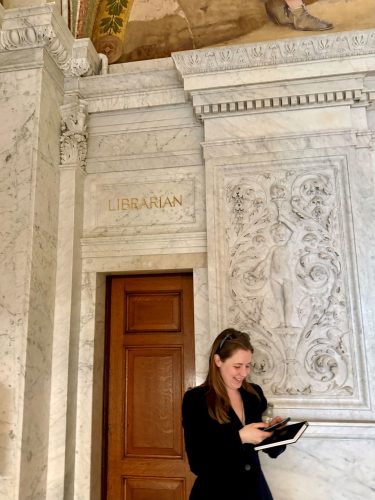
Many thanks to Rosalind Tedford and Sandy Rodriguez for approving the use of my library’s time to advocate for libraries as a whole, and to my LIB 100 students for sharing one day of their in-person class time so I could travel to Capitol Hill for this important work!
6 Comments on ‘ZSR Represented at 50th Annual National Library Legislative Day in DC’
Amazing work, Elizabeth! Thanks for advocating on behalf of NC libraries!
Thanks, Elizabeth, for doing this important work!
This is such important work and valuable to all libraries in NC! Congratulations to you and your working group. This is nothing short of awesome!
You are doing such important and impactful work, Elizabeth! So proud to call you a colleague. Thank you for your strong advocacy for libraries in NC!
This is amazing, Elizabeth! You are a ZSR superstar!!
Thanks for sharing your legistlative day experience! I’m so glad you were able to go. I’m impressed with the examples of the use of LSTA funds!