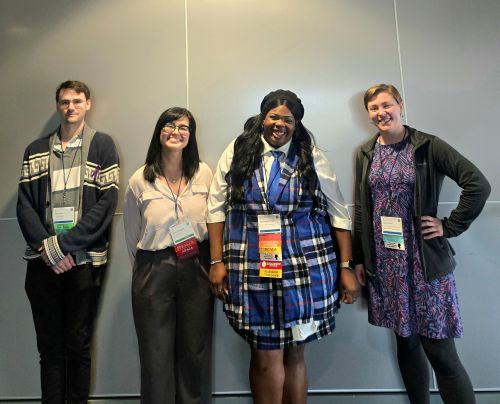
In October, Alayna, Ty, Shabrina, and Sandy traveled to Spokane, Washington for the 5th National Joint Conference of Librarians of Color where the conference theme was Gathering at the Waters: Uplift | Encourage | Empower.
Alayna
Just one week after I attended SEMC, I was on my way to Spokane, WA for JCLC! This was my very first out-of-state conference, and I had a fantastic experience. A cross-country flight was the perfect chance for Ty Wilson and I to plan our session schedules and connect outside of our jobs at Offsite Storage. You can read more about Ty’s experience below.
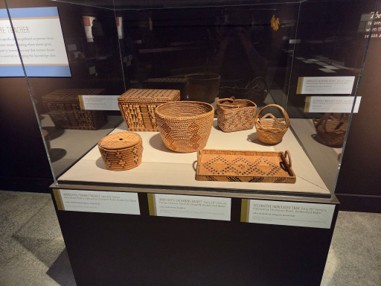
Before diving into the packed conference schedule, I ventured out of downtown into the historic Browne’s Addition neighborhood of Spokane, where I attended a pre-conference tour of the Northwest Museum of Arts and Culture. Washington became a US State in 1889, but the history of this land far predates our young nation. The exhibits on display showcased the traditions of the many indigenous cultures of the Columbia River Plateau. I was particularly captivated by the art of basket weaving, which is primarily passed down through oral tradition and observation. It reminded me of the importance of preserving oral histories, and it makes me proud that we are prioritizing this work in Special Collections & Archives!
Included with museum admission was a visit to the Campbell House, built in 1898 for mining magnate Amasa B. Campbell and his family. I was delighted to tour a historic home in the Pacific Northwest and compare it with the Calvin Jones House at the Wake Forest Historical Museum. I made my first JCLC friends while touring this house, and we stayed together throughout the rest of the conference.
ZSR is my first and only library job, so my goal in attending JCLC was to broaden my perspective within the library field. This conference gave me even more than what I expected! I had the opportunity to connect with library professionals working everywhere from New Orleans to Oregon, from small Special Collections units to massive public library systems. I was able to consider new ideas and approaches for common projects back home, such as student-led reparative description for legacy finding aids. I was also able to support our own Shabrina McPherson and Sandy Rodriguez by attending their conference sessions. You can read more about their experience below.
I’m so incredibly grateful for the back-to-back conference opportunities ZSR has given me this year, and I look forward to sharing and applying what I’ve learned even further. Special thanks to Sandy for answering all of my questions about JCLC and encouraging me to attend!
Ty
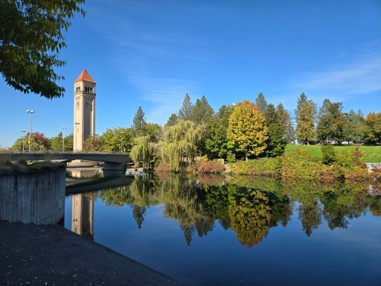
JCLC 2026 was the first conference I’ve had the opportunity to attend, and I couldn’t have asked for a better experience! Spokane was beautiful this time of year, and the convention center provided a wonderful view of the Northern Clocktower and the Spokane River.
Working at a private university (and off-site, away from many of my colleagues), I sometimes worry that I may be out of the loop with library professionals and paraprofessionals in other areas of the field. JCLC was a breath of fresh air in this regard; it was a privilege to attend sessions hosted by our very own Shabrina McPherson and Sandy Rodriguez (more on their excellent sessions below!), along with many other presenters whose energy and passion for our profession was evident and contagious.
The conference schedule was packed and there was plenty to see and do, so while building out my itinerary I tried to balance informational sessions that I could apply directly to my work at ZSR with sessions that gave me a more holistic view of librarianship across different types of institutions.
I started my career working in public libraries before coming to ZSR, so I simply had to attend “From School to Academic to Public: Navigating Multiple Library Worlds Without Losing Yourself”, presented by Danielle McGhee from the University of Notre Dame. It was very affirming hearing Danielle and other attendees discuss the challenges of navigating differing values and expectations between different types of libraries, and walking away with practical exercises to develop personal mission statements that bridge the gap between academic and public libraries was quite helpful.
I also attended Danielle’s presentation “Beyond Clicks and Tasks: Reimagining UX as Spirit, Memory, and Trust”, which illustrated the importance of building trust and fostering relationships through user experience design on digital platforms. This was a great opportunity to reflect on the process of requesting an item from Offsite Storage from a patron point of view and identify what’s working well as well as pain points that may alienate or frustrate users. The approach of centering the user experience around transparency, dignity, and clarity helped me consider our day-to-day processes from a new perspective.
These are just a couple of the most memorable moments of a very busy five days – I hope to have the opportunity to return to JCLC in the future! I’m grateful for the opportunity to attend and spend time with colleagues and new friends.
Shabrina
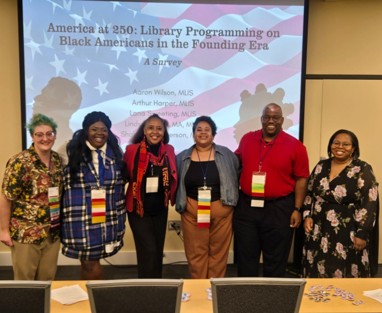
America at 250: Library Programming on Black Americans in the Founding Era
I’m excited to share the impact of a project I worked on with my 2025 ALA Emerging Leaders team, sponsored by the Black Caucus of the American Library Association (BCALA)!
We developed the America at 250: Black Perspectives of the Founding Era toolkit to help libraries, schools, and museums incorporate Black history and agency into their U.S. 250th anniversary celebrations. The toolkit includes a historical timeline, five major themes, discussion questions, and programming ideas.
I’m proud to share that we reached 37 states and 4 countries in just six months! Institutions continue to use the toolkit to create meaningful programs tailored to their communities, including Black History Month programming.
This project highlights the power of collaboration and the importance of telling a fuller, more inclusive story of American history. My ALA Emerging Leaders Group:
- Lindsey Baker, Black Caucus of the ALA, Black Music Studies Scholar and Librarian
- Lana Sweeting, Multnomah County Library, Librarian
- Arthur Harper, Duquesne University, Online Learning and STEM Librarian
- Shabrina McPherson, Wake Forest University, First Year Instruction & Outreach Librarian
- Aaron M. Wilson, University of Maryland, Government Information Cataloging Librarian
Additionally, I connected with like-minded library professionals and attended sessions that deeply impacted my perspective on librarianship. One memorable presentation was “If Found on the Ground, I Have Been Taken by ICE: Safety Bracelets as Library Activism and Mutual Aid” by Serena Vaquilar of Wayne State University.
Vaquilar shared how she uses her library’s laser engraver to create removable safety bracelets with personal information and emergency contacts to help identify and advocate for individuals detained by ICE. The project has grown into a community mutual aid effort, demonstrating how libraries can leverage their resources, makerspaces, and community partnerships to support and protect vulnerable communities. This session reminded me that librarianship extends beyond information access because libraries can also be spaces for advocacy, resistance, and mutual aid.
Sandy
JCLC is a conference I try not to miss because I always leave feeling rejuvenated, and it comes around rarely, roughly once every four years. This year, speaker after speaker shared powerfully resonant stories, critically interrogating dominant narratives by surfacing ones that deserve to be told. In the opening keynote, Jason Reynolds talked about how stories can build our world and also tear it down. His books investigate the internal world of his characters in order to shape new narratives of masculinity and reshape what it means to be a boy. After reading bell hooks’ The Will to Change: Men, Masculinity, and Love last year, I’ve become more conscious of the social pressures shaping boys and men. Overall, I really enjoyed this speaker and found him to be a model of authenticity, a value I’m always striving to enact.
Storytelling comes in many forms, and I’ve found toolkits to be an effective way to empower people toward efforts that surface and shift our collective story. So, I was pleased to learn more about the BCALA-sponosred America at 250 Toolkit! Together with her collaborators, Shabrina is enabling libraries to tell a fuller story of the founding era. In “Uplifting Our Testimonios,” Jesus Espinoza and Sheila Garcia Mazari candidly shared their experiences (testimonios) taking on informal leadership roles, highlighting something many of us have experienced before: responsibility without authority framed as an “opportunity.” They shared what managers can do to support colleagues in these roles: communicate expectations to everyone involved in the initiative, resource it appropriately, build the work into evaluation criteria, identify inequities in who holds informal roles, share credit, and amplify the work. This related well to my presentation on performance evaluations, and I’m still thinking of ways we can appropriately recognize this critical work.
A great segue to my first of two sessions on the same day! With Alex Rivera of Michigan State University Libraries, I co-presented “Empowering Every Voice: Navigating Toward Equitable Performance Evaluations.” We started from a contextual standpoint: No one works alone or outside of a broader structural, relational, and cultural context. Using a scenario, we walked attendees through five factors that shape evaluation outcomes: resource variation, the nature of the work (and what we value), personnel issues, capacity assumptions, and positionality. The accompanying prompts resulted in a lively discussion, though we quickly learned that three minutes was not enough time. I also shared the tiered calibration process we use at ZSR as an example of a structural intervention to mitigate evaluator bias, and we closed with a simple message: Systemic issues must not rest on the shoulders of individuals. Afterward, several attendees recommended we turn it into a workshop, and I’ve been thinking about bringing this discussion to ZSR as we continue to improve our evaluation processes.
In my second session, “Beneath the Surface: How Structural Currents Shape the Gaze on Leadership Styles,” I drew on critical leadership studies to look at why the same leadership behaviors read differently depending on who enacts them, identifying several currents: cognitive, historical, structural, emotional, and physiological. In this session, I focused on servant leadership style, sharing the research, data, and case studies that helped me make sense of my experiences as a woman of color in a formal leadership role. I also engaged in personal storytelling. Instead of sharing the leadership pathway timeline that is typical in leadership presentations, I shared a self-reckoning timeline detailing how internalizing systemic factors as personal failures can take an emotional and physical toll. I provided an example of a structural intervention through work I’m doing as part of ALA Core’s Leadership & Management Competencies Task Force, and left attendees with several paths forward, the most important of which is centered on relationships and connection.
Finally, I think it’s important to convey that at JCLC, we celebrate each other and we have fun! I had the pleasure of witnessing former ZSR colleague Wanda Kay Brown receive BCALA’s Legacy Award, and afterward, the DJ had attendees doing the electric slide and forming the Soul Train line. Another fun and cup-filling experience in the books!
Add Your Comment