
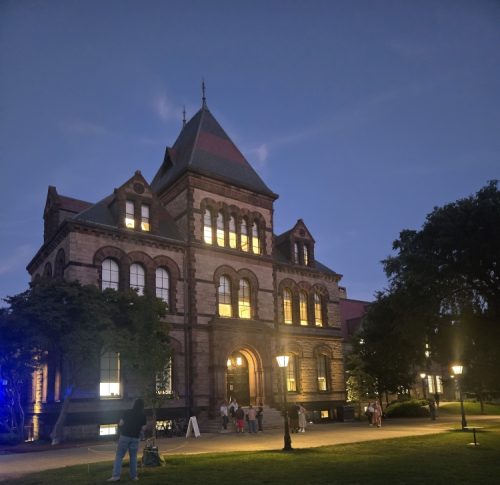
Last month I attended the American Association for State and Local History and National Council on Public History Joint Conference in Providence, Rhode Island. This was the first joint conference between the two organizations, but hopefully not the last! I also spent one day at the Southeastern Museums Conference Annual Meeting in Winston-Salem, which, because of this year’s location, I enjoyed with many of my WFU colleagues! Across both conferences, many of the panels I attended explored how inquiry and personal storytelling can deepen visitor engagement.
At the AASLH-NCPH joint conference, the authors of the newest edition of The Museum Educator’s Manual previewed key ideas in their book, which will be published sometime next year. Brandon Dillard from Thomas Jefferson’s Monticello urged museum educators to make our work as historians more visible by talking about the research behind interpretive content at historic sites and museums. This has been top of mind as we develop an interpretive plan for the Calvin Jones House. One key recommendation of the plan is to develop a research strategy that prioritizes new research and makes time to train our staff and volunteers on the latest historical findings and interpretive strategies. The research plan and findings will be available to our visitors, and we plan to incorporate the research process, not just content, in tours and programming.
Inquiry-based learning was central to a panel discussion on field trips at the AASLH-NCPH joint conference. I appreciated the panel’s emphasis on how inquiry, especially personal reflection, can deepen students’ connections to a museum’s exhibits. Mason Farr’s presentation on the National Veterans Memorial and Museum left me with several ideas to try with students as we develop new field trip offerings. As an example, I wonder how we could use “show-and-tell” to model inquiry. Rather than asking students to investigate an object at the museum, what would happen if we asked students to investigate an object that is meaningful to them? Would students share a single memory about the object, or would they talk about the feelings or people they associate with that object? Then, I wonder how that experience would change how students interact with our exhibits. When they look at an artifact in the museum, would they see “cool stuff,” or a story waiting to be told?
Several of the panels I attended at both the AASLH-NCPH and SEMC meetings reinforced the significance of oral history as a mode of historical inquiry. I was especially motivated by a panel discussion between Courtney Young and Evelyn Del of ForeSight Communications on storytelling and multigenerational engagement. I found one of their most compelling arguments to be that young people bring valuable expertise to museums. At the Wake Forest Historical Museum, we’ve typically focused on oral history and storytelling programs with older adults and community elders or older adults. However, Young and Del argued that “each generation presents something new to the preservation of a cultural moment” and explained how young people are uniquely suited to document or translate the contemporary moment, thereby ensuring the preservation of today’s history for future generations.
Fall tends to be one of the museum’s busiest seasons, which makes taking time to step out of the office, visit with colleagues, gain fresh perspectives, and return home inspired and motivated all the more valuable. As we work to put some of these ideas into practice, we’ll keep you updated through the blog here and our website, wakeforestmuseum.org.
3 Comments on ‘Reflections on AASLH/NCPH and SEMC’
Thanks, Sarah–I love the idea of students exploring and researching an object meaningful to them!
Thanks for your reflections, Sarah!
This was a great synopsis of the conference which gave me a good picture of what it was like and what topics were covered. Thank you Sarah.