

LOEX returned to the East Coast this year for its annual conference, which was held in Norfolk, Virginia on Mother’s Day Weekend. This year’s theme was “Oceans of Knowledge: Diving into Information Literacy,” but the abundant puns and metaphors in presentation titles pointed to the challenges of navigating stranger tides (prime example – a strong contender for this year’s theme was also “Norfolks to give”) and heavy consultation of generative AI tools. One of the strengths of LOEX, in my opinion, is that it truly feels like a conference by and for librarians. There is no vendor or exhibit hall, so conversations are always among peers who generally share professional values and challenges. Dine around and ride share options are organized for attendees so you’re only alone by choice. It’s a great conference to welcome new librarians to the profession, and this year’s venue was a standout among LOEX conference sites.
Amanda
LOEX is my favorite library conference, and this year was no exception. Not to brag (but to definitely brag), but Elizabeth and I must have been favored by the conference gods this year because we got to present during the FIRST session of the conference. That has never happened to me before and getting rid of that anxiety first thing was so fantastic – I’m still happy about it months later. 🙂
If you are curious, we presented our work on Incorporating Critical AI Literacy into Library Instruction. We shared learning outcomes and activities that fit in both one-shot and credit bearing contexts. We’ve since gotten a lot of positive feedback, especially about our prompting bias activity shared on slides 17 and 18, which demonstrated how ChatGPT can summarize the same scholarly source differently depending on the question asked. And if I can brag on her for a little bit, Elizabeth gave an excellent closing on the limitations of critical AI literacy in slides 41-45 that was really powerful, thought-provoking, and show-stopping in the best way possible. All in all, I was really happy with how it turned out.
The session that I haven’t stopped thinking about was about not using AI for brainstorming – Morgan describes in greater detail below, (I seriously think about it at least three times a week, please go read her summary). The other really interesting one I attended was co-led by our colleague down the road, Jasmine Spitler, the Assessment and UX Librarian at Elon University and her former colleague Ashley Blinstrub at George Mason. They presented their robust instructional assessment programs that are truly quite impressive (I bow down). I love to see a fellow NC library rocking it so well.
Elizabeth
I’m not sure that I’ve ever been quite so busy in my career as I was this past academic year, so I confess that I attended LOEX to present and then finish grading senior final assignments to reduce the amount of work I’d have to do on Mother’s Day. I knew we were presenting right after the opening keynote, but ours was the only session I knew about ahead of time. To indulge in a short tangent, I’ll add that I was feeling unusually nervous about our presentation because I assumed that, surely, everyone knew about critical AI literacy already. Perhaps this is the effect of navigating GAI with 180 for-credit students per academic year, where nothing and everything is new, all the time. I was relieved when most of our attendees shared on the Padlet that they knew very little about this topic, and totally vindicated when our presentation was highlighted in the ACRLog LOEX Recap by Eleanor Ball!
Having not seen the conference program in advance, imagine my surprise and delight to run into two of my library heroes, Alexandria Chisholm and Sarah Hartman-Caverly, whose amazing intellectual and instructional work on privacy literacy in libraries transformed the way I think about and teach this topic that is central to library ethics and our ability to find information online. These two have been prolific trailblazers in developing library instruction resources, including engaging CC-licensed workshops and LIS journal articles, as essentially a passion project for years. I applaud their commitment to this topic despite pushback that privacy literacy does not apply to information literacy instruction. Both the ALA Code of Ethics (Principle 3) and Library Bill of Rights (Section VII) explicitly state that users have a right to privacy when using library materials, and I personally have found it increasingly difficult to reconcile our professional ethics with the current reality of digital access. Generative AI is only accelerating this issue for libraries, and Alexandria and Sarah raised the point that with technology constantly moving our ‘literacy’ targets, our unchanging value systems and professional ethics are particularly suited for weathering change and ‘techno solutionism.’
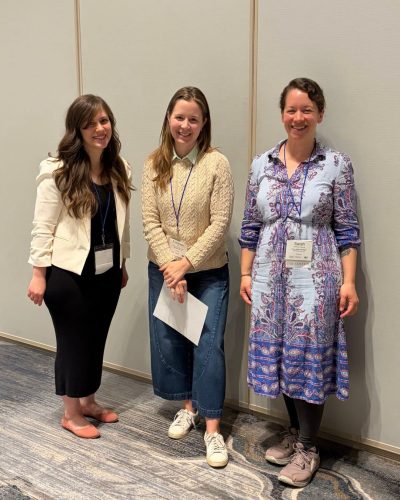
Alexandria and Sarah were presenting at this year’s conference to share their work on “Libraries Stand for Privacy,” a grant-funded national forum to develop library value-aligned and consensus-based national standards and competencies for privacy literacy instruction. I highly encourage you to visit their website to learn more about the project, which includes all library types, and sign up for updates and resources. The principles defined in their collaboratively built privacy literacy competencies move from understanding to action through advocating for privacy and building policies and systems that respect our professional (and human) right to privacy. Imagining and working towards a better information future is critical for our digitally resigned and skeptical students. Their forthcoming book, The Privacy Literacy Field Guide, will be a wonderful addition to ZSR’s collection!
Kaeley
I have wanted to attend a LOEX for several years, but this was my first opportunity! Norfolk was a great location and I’ve never attended a conference where all of the sessions were so committed to the theme! So many nautical puns!
As others have noted, besides the nautical theme, presentations on AI were prevalent, and many (most?) of them were pushing back against the inclusion of AI in education and giving attendees skills to help students critically assess the AI tools that they are encountering. I also appreciated Lane Wilkinson’s presentation, which Morgan discusses below, so I will highlight a non-AI session on reading instead.
“Reading beneath the Surface: Reimagining Information Literacy beyond Search and Evaluating” by Julia Anderson and Megan Heuer from SMU, discussed incorporating reading strategies into both one-shot sessions and for-credit instruction. Since I teach reading strategies in my course for Divinity students, I’m always looking for new ways of presenting this topic. The challenge that Anderson and Heuer presented was: How do we support student research if they are struggling to read [academic sources]? Part of the problem is that students don’t understand what they are looking at, either when reviewing a list of search results, or when attempting to read an individual article. The different types of academic sources, as well as the point of academic writing, are unfamiliar to them and they are overwhelmed by what they are encountering, so they choose the first result in the list and try to make it work with their topic.
In one-shot sessions, the best way to deal with these issues is to model what we do as researchers. Walk students through how we evaluate the sources in a results list and what criteria we use to evaluate which sources can help us answer our research questions and which sources we can disregard. Having students practice these skills in groups by evaluating several articles on a relevant topic, or utilizing a synthesis matrix can help reinforce these skills. In for-credit course instruction, having students practice annotating their class readings, or discussing the readings in groups can also help, as well as utilizing synthesis matrices for larger research projects.
Morgan
This was my very first LOEX! It’s a conference I’ve been wanting to attend since I started in Academic Librarianship so I was happy that the stars aligned and I was able to make it this year. There were a wealth of interesting sessions available to attend and, while most of the sessions I earmarked focused on the intersection of AI and information literacy instruction (shout out to Amanda and Elizabeth for an EXCELLENT presentation btw – it was a packed room and I overheard folks discussing key takeaways from their session the entire conference), I also actively tried to balance sessions on AI with sessions on non-AI related topics (although, AI came up in every.single.session). Alas, my favorite session of the conference was on AI – Lane Wilkinson’s (Univ. of Tennessee at Chattanooga) session “‘Who’s Sailing this Ship, Anyway?’ ChatGPT, Brainstorming, and Epistemic Autonomy”. This session was incredibly thought provoking, looking at the idea of epistemic autonomy – the idea that an individual has the natural right and ability to think for themselves, evaluate evidence independently, and govern their own intellectual and knowledge-based life without undue interference from others – and brainstorming, the role of brainstorming in the research process (and information literacy more generally), and what it means for our students when we condone and even encourage the use of generative AI for brainstorming. A few points that stood out:
- “The independence [having autonomy in research – to choose what questions to ask, what methods to use, how to interpret results, how to present findings] is what allows research to generate new insights, rather than simply repeating existing knowledge.”
- Brainstorming (which is essentially the core beginning stages of research) is tough, especially for students new to research. Take a look at slide 32 – 84% of students find getting started with research the toughest part of the whole process.
- “The brainstorming stages of the research process are the sites of radical self-examination: ‘What do I think about this topic?’ What do I need to learn about this topic?’”
Wilkinson ties the importance of struggling through the brainstorming process to widely discussed concerns about the risks of generative AI and cognitive offloading, suggesting we stop uncritically recommending AI for brainstorming topics or research questions especially if “learning to select and refine research topics is a skill we want students to learn”. Wilkinson did offer some ideas about how to reframe using generative AI in the early stages of research – suggesting that if we are going to offer up gen AI as a tool in the brainstorming process, we encourage students to first generate their own ideas and then use AI to help them evaluate their ideas. Wilkinson also spent some time discussing virtue-based information literacy which I found particularly interesting given the ongoing campus conversation and focus on character and leadership. This session made me think more deeply about the importance of brainstorming in the research process and I’m looking forward to exploring ways to intentionally focus on the role of brainstorming in my teaching and instruction.
2 Comments on ‘ZSR at LOEX 2026’
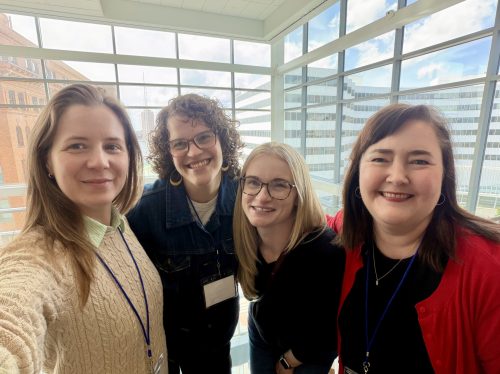
This post is so informative — thanks to all! I really want Amanda and Elizabeth to give their presentation to ZSR! It is a really helpful window into what is happening with AI here. (PS I love the picture of the four of you and it was nice to see a good picture of Norfolk — my old stomping grounds — I worked at ODU for several years.)
Reading this conference writeup makes me want to attend this conference! So many thought-provoking sessions. Congrats on the presentation, Amanda and Elizabeth, and +1 to Lauren’s suggestion on delivering it to ZSR!