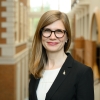
Travel for advancement is the result of a lot of hard work happening here at ZSR, and it’s only worth doing because of that work. The reason to go out into the world and share what we’re doing is that what we’re doing matters, and we want to be able to do more of it.
My role on these trips is to know our work well enough to represent it with care: to have it at my fingertips when someone in a conversation references something that intersects with what we do and wants to learn more. I go out and share the compelling, generous work that you do on behalf of our students, researchers, faculty, and broader community, and I listen for what alumni, parents, and friends of the university are curious about, surprised by, or hoping to see more of. None of this advancement work happens without you, and the only reason any of it happens at all is to find more support for the teaching, scholarship, stewardship, and student experience that you make possible every day.
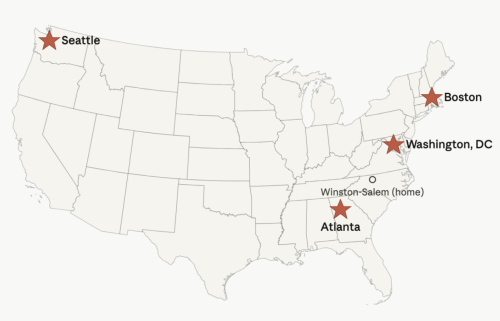
This semester we have traveled to Atlanta, DC, Boston, and Seattle.
This semester Joel and I have been on the road quite a bit. Atlanta, DC, Boston, and Seattle: four cities, four different formats, and a lot of conversations with members of the Wake Forest community about the library and where it’s headed. I wanted to share some of what these trips have looked like, because the work of advancement is often invisible to those of us who spend most of our days in the building, and because what I’m hearing on the road can help shape how we’re thinking about ZSR’s strategic direction.
But first: a note on framing before I get into the cities themselves. None of these initial trips involved directly asking anyone for anything other than time and attention. They were about showing up, sharing where ZSR is headed, and listening carefully to what alumni, parents, and friends of the library are interested in, surprised by, and hoping for. I’m outlining events below, but in each city we also met with individuals over coffee or a meal to hear in more depth from their perspective and questions. So much about the library’s environment is shifting right now: the Presidential search, artificial intelligence, the federal research landscape, Wake Forest’s own bicentennial planning, and growth of the research enterprise. The conversations happening in living rooms and museum spaces and downtown offices are part of how I’m coming to understand what this extended community wants ZSR to be.
Atlanta
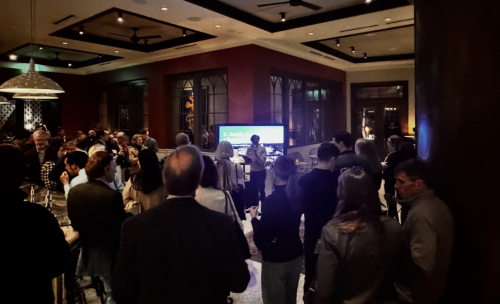
Introducing ZSR at an all call event in Atlanta.
Atlanta was a multi-format visit: a Community Board meeting, a young alumni gathering, an all call event open to any Wake alumni in the area, and several one-on-one conversations. The Community Board format gave me a chance to share what we’re working on at ZSR in some detail and hear back from people who already know the library well. The questions were thoughtful and broad, from how the library supports student programming to how AI is affecting our work. The young alum and all call events were a different approach, but equally helpful. We met at the incoming ZBOV vice-chair’s house (thank you, Sophie Farrara!) and had conversations with people who shared their memory of the library when they were students, wanted to know what’s happening at ZSR now, and had questions about how the library fits into the university’s research profile. Our current chair, Shannon Bothwell, also kindly traveled to Atlanta with us to attend events and speak about the library on our behalf. Several board members showed up across different settings on this trip.
What struck me about Atlanta is how much people wanted to hear about the library’s actual work. There is sometimes an assumption that alumni audiences want a polished, abstract pitch, but I’m finding closer to the opposite: people want concrete details and discussion about what we are doing, what is changing, and what students are experiencing.
Washington, DC
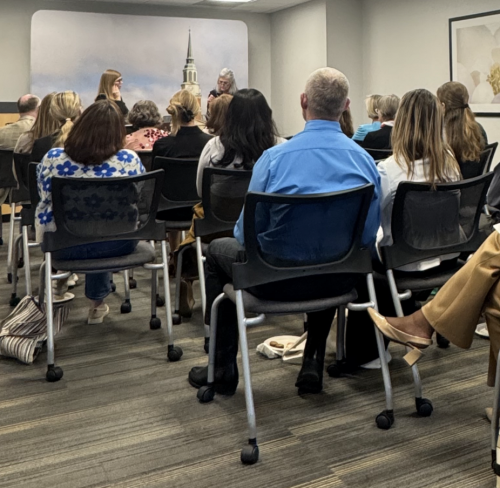
Laura Elliott and Lauren Pressley in conversation
The DC trip centered on an author talk with Laura Elliott on her book Truth, Lies, and the Questions in Between. WakeWashington hosted this interview in which we explored the nature of historical fiction, the use of primary sources in storytelling, and the importance of institutions that preserve and share the truth.
This talk was paired with a behind-the-scenes visit to the National Archives. A group of ZSR supporters joined us for the archives portion, where we spent time with materials including Washington’s handwritten inauguration speech and the nomination of Thurgood Marshall to the Supreme Court. Being in a room with documents like those, alongside people who care deeply about Wake Forest and about archives, surfaced a kind of conversation that doesn’t happen anywhere else. The questions about provenance, preservation, access, and the responsibilities institutions hold toward the records they keep felt particularly resonant given the work we are doing around our own collections and around the integration of the Wake Forest Historical Museum into Special Collections and Archives.
The author talk and the archives visit worked well together. One was about how we make sense of evidence and narrative; the other was an encounter with the actual artifacts of the historical record. The two reinforced each other in ways I hadn’t fully anticipated when we planned the trip. We also enjoyed our next ZBOV chairs’ participation, having the opportunity to connect with Bruce and Mary Summers.
Boston
Boston was anchored by a Community Board meeting and a parents event hosted by new ZBOV members/parents, Wendy and Gordon Cromwell. The Boston Community Board, like Atlanta’s, was deeply engaged with both the library’s broader trajectory and with AI specifically. What stood out about the parents event was how well the hosts framed the library for their peers. Wendy spoke about ZSR with an authenticity I could not have matched, because she was speaking as a parent to other parents about what her own daughter has experienced. Wendy and Gordon also introduced me around the room with enough context that I could meet each person where their interests actually were, rather than delivering the same overview repeatedly.
This pattern of community members doing the framing, with me there to go deeper on whatever piece an individual wanted to explore, is something I am increasingly convinced is the right model for events like these. The credibility of a peer voice is real, and the conversations that follow are noticeably different in texture than when the dean is the one making the case.
Seattle
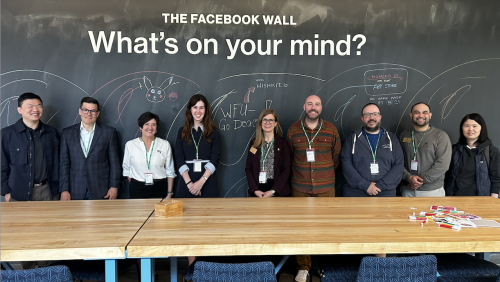
A photo from one of our small group meetings in Seattle.
Seattle was a different kind of trip: one library focused event and three AI-focused events over a short window, each hosted by a Wake Forester working in a different company. The cohosts were not just opening their spaces; they were actively shaping the conversation, drawing on their own work to ground the discussion in what AI is actually doing in their organizations, what they are seeing in recent graduates, and what they hope Wake Forest can do to help students navigate this landscape. It was great to see ZBOV member Steve Duin at one of our meetups.
I opened each gathering with some framing about the moment Wake Forest is in and what ZSR is positioned to do, particularly around teaching and student success. Our for-credit research course consistently fills with waitlists, which gives us a serious place to do the harder work this moment requires. ZSR has a long history of being pragmatic early adopters of new technologies and helping the Wake Forest community navigate them together. We are doing that again with AI, not as a defensive posture against new tools but as a serious investment in helping students become discerning thinkers who can tell what they actually know from what an algorithm has assembled for them.
What I heard back from the rooms was rich. People working in tech, in product, in research, and in client-facing roles all spoke about the same underlying concern in different vocabularies: that the work of judgment, of knowing when to use these tools and when to set them aside and think for yourself, is becoming more important rather than less. That communication and critical thinking remain paramount. That is the work the library has always supported. The technology changes. The underlying work does not.
What I am taking back to ZSR
As I pull together thoughts from this stretch of travel, I find myself reflecting on how the Wake Forest community is hungry for substantive conversation about what the library is doing and where it is going, and that conversation is most generative when the format invites listening rather than presentation. The peer-to-peer framing that worked so well in Boston and the co-host as co-facilitator model in Seattle are both worth carrying forward. The questions people are asking about AI, about evaluation, about what kind of judgment students need map closely onto the strategic priorities we are already working on. These experiences are affirming much of what we are working on, and they are also asking us to go further
And with that, we’re through the Academic Year 2025-2026 advancement travel! We’ll host our ZBOV meeting on Zoom this summer, and continue one-on-one conversations in Winston-Salem or on Zoom, and begin planning for the cycle of visits next year.
What makes these trips possible
Each of these trips represents a lot of pre-work. Joel Rivera has put an incredible amount of thought, planning, and logistics work in organizing each trip, and colleagues in advancement: Sarah Cave, Jennifer Richwine, Isabelle Christensson, and Kylie Miles have all put in many hours to help us have a successful visit in each of these cities. These advancement colleagues understand what ZSR means to our community, and they’ve put significant effort into helping our work shine in local alumni and parent communities. It’s a great partnership!
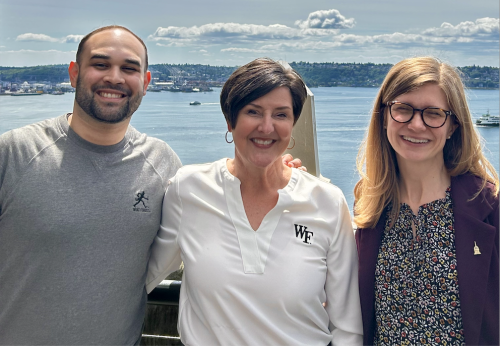
Joel Rivera, Sarah Cave, and Lauren Pressley, with the Puget Sound in the background.
7 Comments on ‘Notes from the Road: ZSR on Tour’
Sharing these stories is amazing! Hearing what happens on these trips is fascinating! I really appreciate learning what alumni are focused on in these sessions and approaches y’all take for these sessions!
This is so wonderful. The engagement of the ZSRBOV is astounding and so valuable. Thank you Joel and Lauren!
Cheers to everyone who makes this work happen, and thanks, Lauren, for sharing!
This is all amazing! Thanks so much for taking ZSR on the road, telling our story, listening and addressing questions. You’re rock stars!
Thank you so much for sharing about this!
Thank you for sharing the important work you’re doing to engage the Wake community and promote the good work of ZSR Library and our role in the university and beyond. It’s so refreshing to learn more about advancement work. A big shout-out to Joel and the advancement team for ensuring a smooth takeoff for our new Dean!
Thanks for sharing! The format differences from city to city were interesting to read about. It doesn’t surprise me that the ones that resonated most were collaborative and conversation-driven. A library’s work is a conversation of sorts, so it makes sense that that is how to best share about ZSR!