
I recently attended the annual meeting of the Association of Librarians and Archivists at Baptist Institutions (ALABI) in Charleston, South Carolina. The conference was held in a hybrid format, bringing together approximately 25 participants both in person and online. I always find these meetings rewarding because they provide dedicated time to think about our Baptist collections, the researchers who use them, and the broader challenges and opportunities facing archives and libraries at Baptist institutions.
The meeting featured a variety of presentations and discussions on topics related to Baptist history, archives, and preservation. I particularly enjoyed Marcia’s excellent presentation, “The Biblical Recorder and Early American History,” which she will be sharing in a future blog post.
I also participated in a panel discussion, “Digitizing Church Records: Balancing Access, Cost, and Stewardship,” alongside colleagues from Samford University, Southeastern Baptist Theological Seminary (SEBTS), and Mercer University. Our conversation focused on several important questions facing institutions engaged in church records digitization:
- What does your institution’s church digitization program look like, and what goals are you trying to accomplish?
- How do you communicate the value of investing in digital preservation when your institution and the church may define that value differently?
- How do you fund and sustain your digitization program?
- How do you approach permissions, copyright, and access when working with the various Baptist entities?
- What has been the most significant challenge your institution has faced in digitizing church records, and how have you addressed it?
By the way, SCA’s most significant challenge has been to proactively manage the various tools and platforms for our growing digital collections, while also responding to technological obsolescence, the need for long-term digital preservation, and third-party vendor changes and buyouts.
One of the highlights of the meeting was a tour of First Baptist Church on Church Street in Charleston. The congregation was founded in 1682 in Kittery, Maine, before relocating to Charleston in 1699. The current sanctuary, which we toured, was completed in 1822.
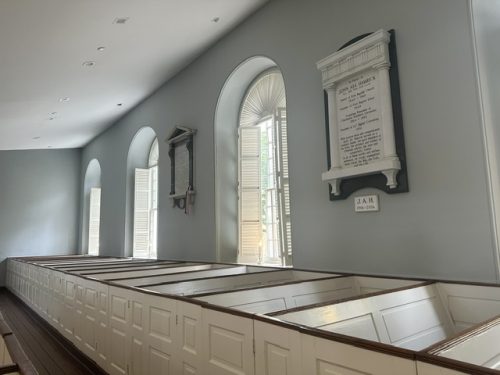
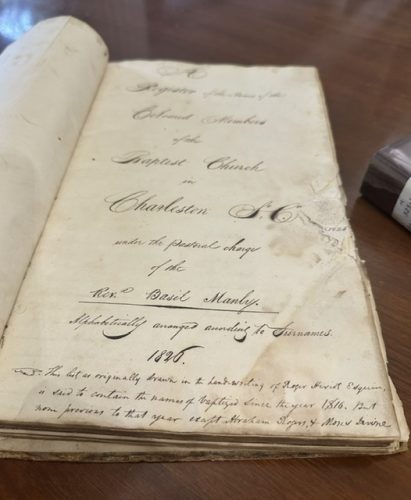
During our visit, we viewed an original membership register that recorded both white and Black members. Although they were entered in the same volume, the lists were maintained separately—a powerful reminder of the racial divisions that existed within the congregation. The register was recently digitized by Southeastern Baptist Theological Seminary in Wake Forest, North Carolina.
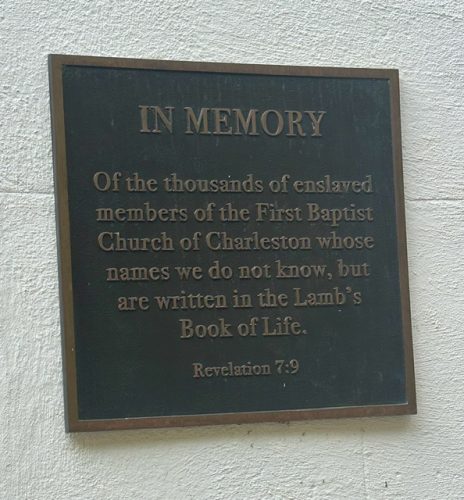
We also saw a recently installed plaque commemorating the enslaved members of the church and marking the entrance they were required to use.
Although the meeting was brief, I once again found ALABI to be both inspiring and thought-provoking. It served as an important reminder of Wake Forest University’s Baptist origins and of the ongoing responsibility we share to preserve, interpret, and make accessible the records that document this complex history.
2 Comments on ‘(ALABI) Association of Librarians and Archivists at Baptist Institutions Annual Meeting in Charleston, SC’
“…SCA’s most significant challenge has been to proactively manage the various tools and platforms for our growing digital collections, while also responding to technological obsolescence, the need for long-term digital preservation, and third-party vendor changes and buyouts.” Collection development/management and technical services employees all over can completely empathize with your challenge, as we are challenged exactly the same way in the realm of commerical publication curation. 🙂
Thank you for investing well in the Baptist records! Church records are such an important window into history!
Great write-up, Tanya. Thank you for sharing your expertise!