This summer, I had the pleasure of supervising Margaret Marpoe during her internship with Special Coactions and Archives. As part of her MLIS program at the University of Alabama, Margaret spent the summer at ZSR gaining hands-on experience creating a digital collection. Her primary project focused on digitizing portions of the Samuel and Sarah Wait Papers.
In the guest post below, Margaret reflects on her internship experience, the skills she developed, the people she learned from, and what she discovered about the collaborative work that goes into making archival collections accessible.
Hi, I am Margaret Marpoe. At the beginning of 2026, I began pursuing my Master of Library and Information Science (MLIS) with a concentration in Archival Studies through the University of Alabama’s online program. As part of my coursework, I completed a 150-hour internship at Z. Smith Reynolds Library’s Special Collections and Archives from May 26th through July 29th. The goal of my internship was to gain hands-on experience with every step of a digital collections project, from digitization and metadata creation to online publication, digital preservation, and outreach.
Throughout the internship, I had the opportunity to work with several different collections and learn a variety of digitization techniques. My primary project, however, was digitizing boxes 5 through 9 of the Samuel and Sarah Wait Papers, a collection documenting the lives of Samuel Wait, the first president of Wake Forest Manual Labor Institute (now Wake Forest University), and his wife, Sarah “Sally” Wait. The portion of the collection I worked with consisted primarily of correspondence from the 1840s, providing insight into the personal, religious, and educational lives of the Wait family.
Learning the Department
One of the most valuable parts of my internship was getting to meet members of the Special Collections and Archives team. Both the one-on-one meetings and the bi-weekly team meetings that I attended gave me a much better sense and appreciation for the many different roles that work together to preserve and provide access to collections.
On my first day, I met with my supervisor, Melde Rutledge, the Manager of Digital Collections, who introduced me to the internship and walked me through my schedule for the summer. He also introduced me to the digital collection I would be working with and went over the metadata and the metadata standard that they use called Dublin Core.
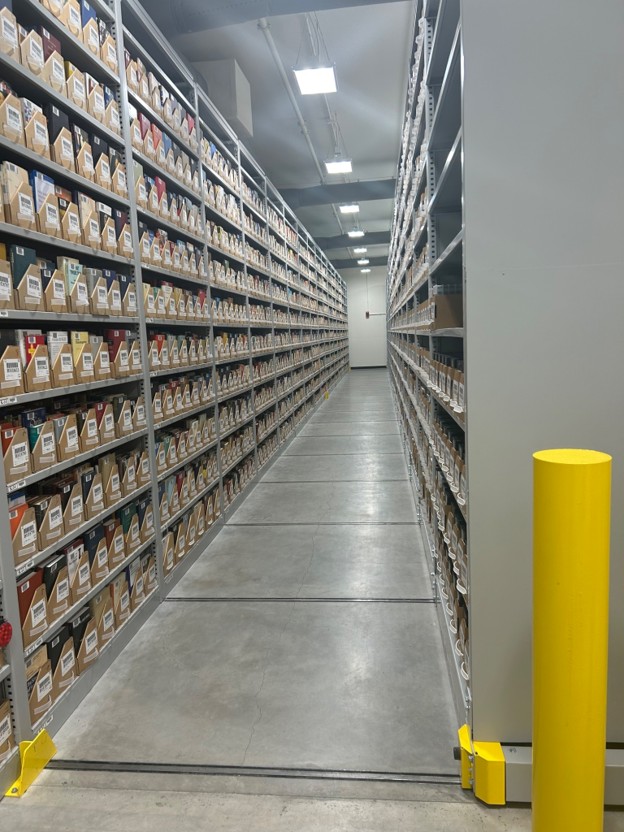 I then had the opportunity to visit the archive’s off-site storage facility alongside the other intern, Amy Archambault. There, I met with Alayna Veasey, the Collections Specialist, and Tyler Wilson, the Offsite Collections Coordinator. They gave me a tour of the facility and explained how collections are organized, stored, and retrieved. Seeing the scale of the storage facility firsthand gave me a new appreciation for the planning and organization required to manage that many collections while still ensuring that materials remain accessible when needed.
Next, I met with Craig Fansler, the Preservation Librarian; he gave me an inside look at the physical preservation side of archives. He demonstrated how archival boxes and custom protective enclosures are made to safely house materials, and he also showed me how to operate the printing press. It was fascinating to see the craftsmanship involved in preserving collections.
I also met with Ashelee Gerald Hill, the Access and Outreach Archivist, who shared the many responsibilities involved with outreach. I then met with Rebecca Peterson May, the Head of Public Services for Special Collections. She gave me a better understanding of how researchers and the public interact with archival collections. She demonstrated the reference request process and showed how fulfilling requests is truly a collaborative effort across the department. She also discussed some of the practical limitations archives face, explaining that because of limited staff time and resources, larger digitization requests sometimes need to be outsourced or turned down.
During my meeting with Megan Mulder, the Manager of Distinctive and Rare Materials, I learned about the wide variety of responsibilities involved in managing rare and distinctive collections. She also shared how she incorporated special collections into the classes she teaches, demonstrating another important way ZSR Special Collections and Archives supports teaching and learning.
During the final weeks of my internship, I also had the opportunity to meet with several additional members of the team. First, I met with Lauren Pressely, the Dean of the Library, who spoke about her role in leading the library and the importance of collaboration across departments. I then met with Tanya Zanish-Belcher, the Director of Special Collections and Archives and Executive Director of the Wake Forest Historical Museum. She shared her experience transitioning from archivists to director, discussed the day to day responsibilities of her position, and offered valuable advice as I began my career. Next, I met with Kate Trathen, the Processing Archivist, who explained her different roles in accessioning and then processing collections. I then met with Beth Todford, the Copy Cataloging and Database Maintenance Specialist, who walked me through the process of cataloging and her career trajectory. Lastly, I met with Sam Sfirri, the Head of Archival Collections. He talked in detail about how a collection is accessioned and processed as well as how and which collections are accepted by the university.
In addition to these individual meetings, I attended the department’s bi-weekly staff meetings. These meetings not only allowed me to speak about what I was working on but also to hear updates from every member of the team, including those I did not meet with individually. It was interesting to learn about each person’s ongoing projects and responsibilities, but what stood out to me the most was seeing how interconnected everyone’s work is. Whether working in preservation, digital collections, public services, outreach, or collection management, each role contributes to a common goal of preserving materials and making them accessible to researchers.
Digitization
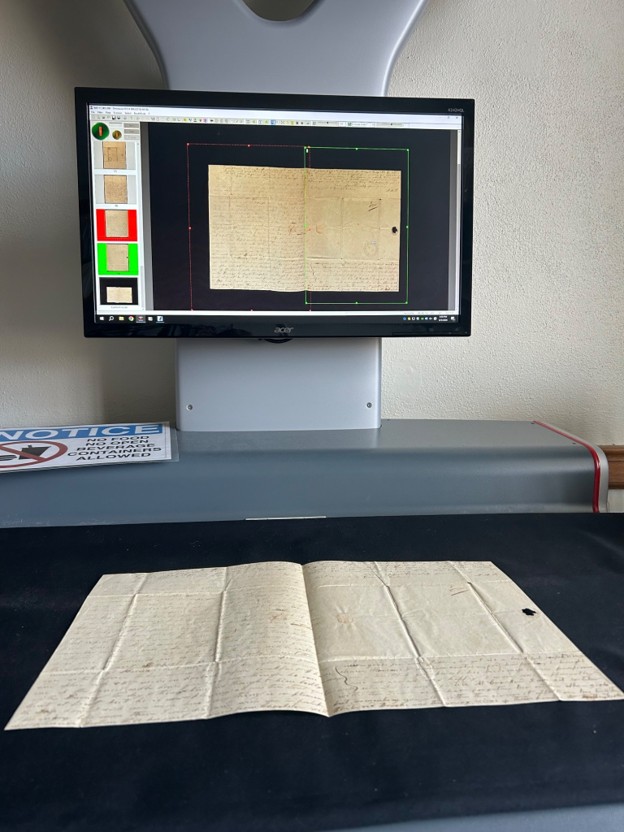 Over the course of my internship, my primary responsibility was digitizing the Samuel and Sarah Wait Papers, a collection consisting primarily of correspondence dating from the 1840s. My first task was learning how to operate the Zeutschel overhead scanner. Along with learning the scanner’s software, Omniscan. As the weeks went on, I learned how to organize and save master files, troubleshoot issues with the scanner, and prepare files for the next stages of the digitization process. While much of this collection consisted of loose correspondence, some materials presented some challenges. There were several bound volumes that I could not manually flatten, so I had to learn to use the second Zeutschel scanner that is equipped with a glass plate to safely digitize these materials without causing damage. Toward the end of my internship, I also had the opportunity to learn additional digitization techniques using a flatbed scanner. This allowed me to digitize photographs as well as positive and negative film from the University Archives Photograph Collection. I also got to work briefly with Adobe Photoshop to strengthen some scans.
Creating Metadata
After scanning in the materials, the next step was creating the metadata. Without this metadata, researchers and others who are interested would have no practical way to discover or understand the thousands of digitized items housed in the archive. Metadata is what makes the scans useful and findable. The ZSR Special Collections and Archives uses the Dublin Core metadata standard to organize its metadata. This includes information such as titles, dates, creators, descriptions, subjects, and other terms that are all organized in a spreadsheet. The use of a metadata standard is important because it ensures that every item has the same type of data fields filled out as well as controlled vocabulary to make things easier to find. In order to make sure I was using the correct controlled vocabulary; I consulted the Getty Art and Architecture Thesaurus. That spreadsheet was later imported into the digital collections platform Quartex.
Publishing the Materials Online
Once the digitization and metadata were complete, I learned how to publish the materials through the ZSR’s digital collections platform, Quartex. The first step is uploading the access PDFs of the scans onto Quartex. From there, I imported the spreadsheet with all of the metadata. Quartex automatically identifies missing information and potential errors, allowing them to be corrected before publication. Once everything looked correct, I was able to publish the PDFs and metadata onto the website. Seeing the first portion of the Samuel and Sarah Wait Papers that I scanned appear online was one of the most rewarding moments of the internship, and it was so cool to see that process from beginning to end.
Digital Preservation
After the collection was completed and published online, the next step was to transfer the files onto Amazon Web Services (AWS) for long-term preservation. While making the materials available online is very important, it is also essential to ensure the files are preserved long-term.
Outreach
Making collections available online is only effective if people know that they exist. Writing this blog post gives me an opportunity to contribute to the Archives outreach efforts. It has also allowed me to reflect on everything I have learned while also sharing with others what goes into preserving, digitizing, and providing access to historical collections.
Reflection and Conclusion
Looking back on the last two months. This internship has been an invaluable experience and has strengthened my desire to pursue a career in archives. Before beginning at ZSR Special Collections and Archives, I had a general understanding of the work that archives do. But this internship allowed me to experience firsthand everything that goes into making historical materials accessible to researchers. I learned that a successful digital collections project is much more than simple scanning documents. It is a collaborative process that depends on digitization, metadata creation, preservation, public services, outreach, and the expertise of many different people working together toward one common goal.
One of the most rewarding aspects of the internship was seeing the complete lifecycle of a digital collection. I was able to take the Samuel and Sarah Wait papers from physical documents to digital images, to searchable online resources, and finally to long-term digital preservation. Watching the collection become available online after spending weeks working on it gave me a real sense of accomplishment and showed me how meaningful archival work can be. Beyond the technical skills I developed, I also gained a much deeper appreciation for the people behind the work. Meeting members of every area of the archive showed me that archives are truly collaborative environments. Each person’s role contributes to preserving history and ensuring that these collections remain accessible for future generations.
I am incredibly grateful to Melde Rutledge for his mentorship throughout the internship and to everyone at ZSR Special Collections and Archives for welcoming me, sharing their knowledge, and taking the time to speak to me and answer my questions. This experience has given me a strong foundation to continue my MLIS program, and I look forward to building on these skills as I pursue a career in archival work.
4 Comments on ‘A Summer in the Archives: Digitizing the Samuel and Sarah Wait Papers by Margaret Marpoe’
You were such an asset to the team immediately and I know you will go far in the field. Do stay in touch!
It was cool to read about the process from beginning to end! Nice write-up, good work, and good luck in your career!
I’m glad you had such a meaningful internship. Good luck in your future work!
Thank you for sharing about your internship experience which will serve you well in your career pursuits. Best wishes!