
Last week I traveled to Richmond to attend the Mid-Atlantic Regional Archives Conference (MARAC). I went a day early to attend a workshop focused on donor relations in Special Collections and Archives. My workshop was followed by two days of sessions.
I chose the workshop to improve my understanding of donor relationships and public facing roles. I found the workshop very informative, topics covered included internal education, identifying collections opportunities, working with advancement, and enhancing collection development policies as methods to improve donor relationships and collections development processes. We were all highly engaged in the group activities; we collectively did a SWOT analysis of specific issues and helped brainstorm solutions for donor issues. Additional considerations that were mentioned during the workshop included “AI clauses” for donors to disclose if materials were created using AI. We also learned about the soft skills (radical empathy and trauma-informed care) needed when cultivating relationships with donors. While institutions and repositories promote the historical and research value of collections, there is still the human element to be considered, and having strong interpersonal skills is just as important as strong documentation.
Sessions
“When Churches Die,” – presenters shared how to help preserve the records of churches with shrinking and/or dying congregations. Archivist, Gwen Wells, of Jones Memorial Library presented the cases of two different churches – Fairview United Methodist Church and Rose Chapel Baptist Church. When she was approached last February by a descendant of First United’s founding family, Wells said the church’s heat had already been turned off and members were meeting in a smaller room.Wells framed her work as that of a death doula and used terms like “hospice” and “critical care” to describe the operating conditions of the two different congregations she was assisting. Fairview Methodist already had a history room, with scrapbooks, photographs, and other historical items. Wells served as more of a consultant to help Fairview members identify materials for preservation as well as provided vendor information so they could purchase preservation tools to prep the items they wanted to preserve. The collection is now housed at Jones Memorial Library in Lynchburg, VA, but Wells allowed members to arrange and describe the collection themselves.
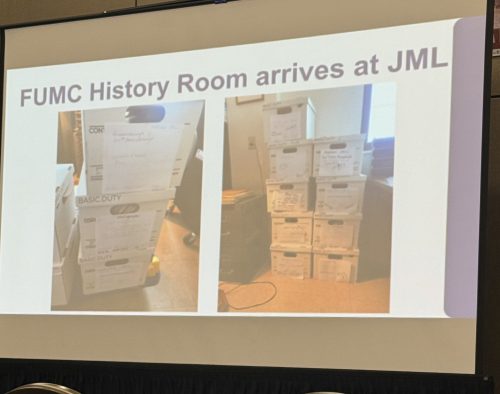
The other church that Wells worked with is Rose Chapel Baptist Church (still operating but the congregation is shrinking and they have no pastor). Wells was approached by the son of a Rose Chapel member to preserve the memory of the church before the congregation was gone. Of note: Rose Chapel is a Black church in the Madison Heights community that has been impacted by the highway construction and this collection is comprised of two different sets of oral history interviews that discuss the church’s history and the history of Madison Heights. I really enjoyed this session and hope that the presenters turn it into a workshop. (Presenters also acknowledged gender nuances in the work of placemaking and community building which I could elaborate further on this topic, but would be happy to discuss it in more detail if anyone is interested!)
“AI for Access” – this session was the shared results of a data study. Presenters surveyed 98 archivists and librarians about using artificial intelligence for work. Key findings were that archives associated with larger institutions were responsible for the most AI use among survey participants. Additionally, a significant number of AI users were in administrative roles, using AI to perform the more analytical tasks associated with their jobs. Towards the end, the results showed specific AI tools used for ingest and public access (ChatGPT , Whisper, and Microsoft Copilot were common).
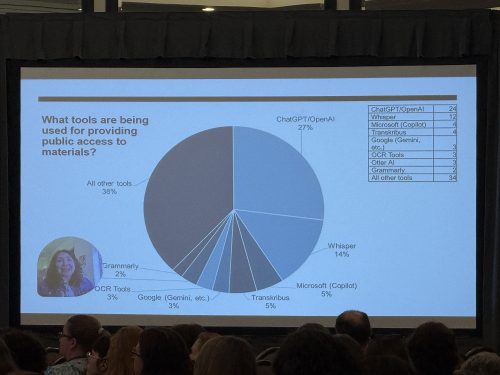
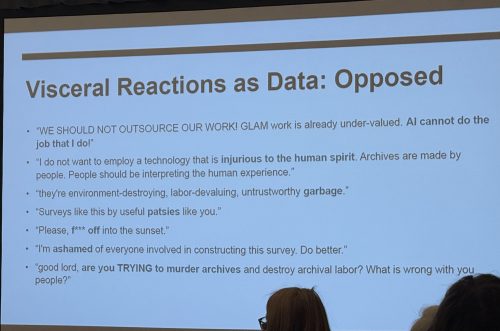
I left having more questions than answers. This reminded me of the “AI clause” mentioned during my workshop, (i.e. rejecting AI produced materials, but also declaring to protect collections from AI); but it’s clear that archivists are already using AI tools for collections work. Furthermore, how does using these tools factor into collections of underrepresented and marginalized groups, where there are already issues of trust and AI bias to consider. Should institutions make donors aware that they use artificial intelligence on collections?
Other sessions of note included using a personal archive of games and gaming systems to study musical composition; and navigating copyright with third-parties. The poster session was also interesting and covered a couple of reprocessing projects; acquiring an entire Civil Rights Era collection that was locked in a Baltimore rowhouse basement for 30 years; and the issues with baking spliced reels for big A/V digitization projects. Overall, I had a great learning experience at MARAC and look forward to the virtual conference in the fall.
9 Comments on ‘Ashelee @ MARAC’
What a great conference! Loved hearing about all the sessions. 🙂
What an interesting conference. The sessions sound so valuable! I am glad steps are being taken to preserve dying church records. As a person with a great deal of interest in family ancestry, that information is pure gold!
Thank you for sharing, Ashelee! I believe you highlight a very important issue when you question how AI tools factor into collections from underrepresented and marginalized groups.
Thanks, Ashelee—sounds like the MARAC conference continues to be a great resource for archivists, appreciate your sharing!
Thank you for sharing your takeaways as well as a critical interrogation of presented material.
Ashelee, I so enjoyed reading this as well as our discussion about dying churches. Churches, like people, have a life span and each one’s demise should be informed by its unique life. I appreciate the caring insight you bring to collections.
Thank you for this excellent conference review, Ashelee. I really appreciate reading your words on such an interesting and relevant topic to our collections.
Thanks for sharing all of this Ashlee! If approached by a dying church, one thing to keep in mind is the structures already in place with various denominations. I had cause to investigate what the Presbyterian Church USA has to say about records/archives in the past and found this guidance online: https://pcusa.org/historical-society/services/records-management
Sounds like and interesting and valuable conference, thanks for reporting.