
On February 19th-21st, I attended the Workshop on International Skills Enhancement Conference (WISE), hosted at Brookstown. Through a grant, I was able to attend one of WISE’s preconferences, “Intentional by Design: Pedagogical Strategies for Meaningful Intercultural Learning,” led by Melanie Robbins and Jami Leibowitz of East Carolina University (ECU). The session focused on pedagogical approaches that support intercultural learning, including perspective-taking, inquisitiveness and openness, respectfulness, adaptability, tolerance of ambiguity, empathy, and self-awareness. Although many of the strategies were familiar to me, the session pushed me to think more intentionally about how I already use them, and how I might adapt them to better support both course learning outcomes and intercultural learning in my study abroad teaching.
Activity 1: “Photo Menu” With this icebreaker activity, students are asked to introduce themselves by choosing, and sharing, a photo from their phone (or they could Google one) that represents either:
- Everyday life: Share a photo of something ordinary or everyday from your life. This might be a routine, a space, or a small moment that gives others a glimpse into how you experience the world.
- Something unexpected: Share a photo that says something important about you, but not in an obvious or expected way. Be prepared to explain what others might assume and what the photo actually represents to you.
- Something they value: Share a photo that represents something you value. This might reflect a belief, commitment, relationship, or principle that matters to you.
- A place they call home: Share a photo that represents a place you consider “home,” however you define that. This might be a physical place, a community, or something symbolic.
The photo from my camera roll that I shared as an example:
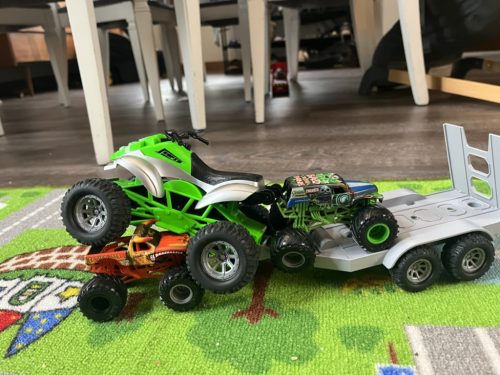
This photo sums up my life outside of work pretty well: lots of trucks, lots of imagination, and a two-year-old in charge. If I’m not at work, I’m usually on the floor playing with him. In this case, he had engineered a truck crash he was very proud of and made sure I documented it for his grandparents. It also reflects something that matters a lot to me, making time to be playful and present with my kids.
This was a unique way of breaking the ice that I had never seen before. I could see this working especially well in learning environments where relationship-building matters but can be difficult to foster quickly, including study abroad courses, asynchronous instruction, workshops, and one-shot sessions. This activity also reminded me that intercultural learning can begin with belonging and self-definition, not just content.
Activity 2: “Thinking Hats” With this activity, students are given a hat representing a role in an attempt to help students discuss tough topics. The hats represent the following:
- The Facilitator
- The voice of caution
- The feeler
- The fact checker
- The creative thinker
- The optimist
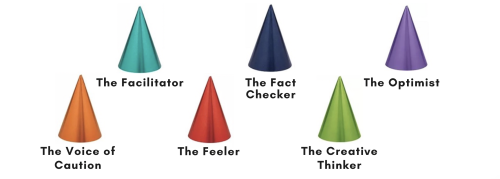
Photo from preconference slides, shared by Melanie Robbins & Jami Leibowitz
Some variations of this activity include:
- Pause the activity and have participants switch hats; continue the current discussion with participants considering different perspectives.
- Have participants switch hats and discuss a new topic from their new perspectives.
- Have participants identify various stakeholders related to the discussion topic; assign each stakeholder a hat and discuss.
I was especially drawn to the possibility of adapting this activity for source evaluation, AI literacy conversations, and discussions of controversial business or social issues, where students often need support distinguishing evidence from reaction, caution from creativity, and critique from optimism.
After trying out the thinking hats activity, we had a few minutes to reflect, and I found myself thinking about how some of these ‘hats’ are ones we naturally tend to wear, while others are ones we usually avoid. Participating in this activity challenged me to think in new ways, and I can see how that kind of challenge could be valuable in many different contexts.
Activity 3: Visual Analysis With this activity, we were given three different photos and asked to answer three questions about them:
- What’s going on in the photo?
- What do you see that makes you say that?
- What more can you find?
An example of one of the photos we were given to look at:

Image from Adek Berry
I thought this activity would be great for pre-departure preparation. Students could examine images of places, situations, or cultural contexts they may encounter abroad and begin identifying their own assumptions, biases, and expectations before departure. This activity can easily be connected to visual literacy, for instance when teaching interpretation of data visualizations, or even with pre-research exercises where students examine what they think they know before they start.
One of the most surprising parts of the workshop was hearing the presenters share assessment results from ECU on student learning outcomes related to perspective-taking, inquisitiveness and openness, respectfulness, adaptability, tolerance of ambiguity, empathy, and self-awareness across their study abroad and virtual exchange programming, as well as their global learning courses. According to the presenters, study abroad showed statistically significant results in several areas, but virtual exchange showed especially strong results for perspective-taking and respectfulness that study abroad did not show.
That finding challenged some of my assumptions about what kinds of learning experiences produce intercultural growth. Before this session, I was not familiar with virtual exchange as a pedagogical model as an alternative option to study abroad. Now I am curious to learn more and to consider whether there are virtual components I could integrate into traditional study abroad course, or even my other information literacy courses, to better support perspective-taking and respectfulness.
Aside from the preconference, another session I attended stood out to me. This session was titled, Lessons from Five Weeks of Student-Led Research in Valencia, Spain: Cross-Cultural Engagement as a Path to Personal and Intellectual Growth and was presented by WFU student, Sophia Sanders, and WFU Faculty member, Encarna Turner. In this session Sanders talked about her experience as a Richter Scholar, in which she was sponsored by Professor Turner and went to Turner’s hometown in Valencia, Spain to conduct research following the 2024 floods. Before this session, I had not really heard much about the Richter Scholarship program. Learning about it expanded my thinking about what could count as an outcome of high-impact learning experiences or even a LIB course. I also started to wonder how our classes can help students move from course participation in research to independent inquiry.
Overall, this conference prompted me to think more intentionally about how classroom and community-building activities can support intercultural learning, not just engagement. I see real potential to adapt these strategies for instruction, workshops, and collaborations in which students are interpreting unfamiliar contexts. The discussion of virtual exchange made me think more broadly about scalable, lower-barrier intercultural learning opportunities, especially for us in the library-context, while the Valencia session reminded me that research support and faculty partnerships can help students move from course participation to independent inquiry. More than any single activity, the conference highlighted for me the important role teachers play in bringing together effective teaching strategies, community-building, and intercultural learning.
7 Comments on ‘Summer @ WISE 2026’
Thanks for sharing these great activities! Sounds like a great conference!
What wonderful community-building activities! Thanks for sharing!
Great summary, Summer! That pre-conference has me thinking of ideas for our team retreat in August when we will have new team members who will need to get to know us and we will need to get to know them!
Such an interesting experience, thanks for sharing.
Wow, Summer, this is awesome! I think that virtual exchange was part of the concept of our last QEP, Global Wake Forest, because there was a component for people here (employees too, not just students) who don’t get the opportunity to go abroad, except that terminology maybe didn’t exist yet then. I’d love to hear more about that — maybe we can have coffee — virtually, even! 🙂 I think I might be able to use some of the ideas you shared in this post in a practical application too. Thanks so much for this post!
You picked some great photos to share, Summer! Thank you for sharing the creative activities and your takeaways from the WISE conference.
Thanks for this great recap, Summer. The activities are impactful! I hope you find them useful in your future endeavors with students!