
After a 6-year hiatus, the ABCs of Special Collections series has returned! This blog post was written by my student employee Taylor McGrew, a senior double majoring in Philosophy and Politics & International Affairs. What started as a simple writing project for Taylor turned into processing her very first collection from start to finish, all under the experienced guidance of Collections Archivist Sam Sfirri. The complete finding aid for the Norwood Family Papers can be found here. Congratulations on this major accomplishment, Taylor!
ABCs of Special Collections: N is for…
The Norwood Family
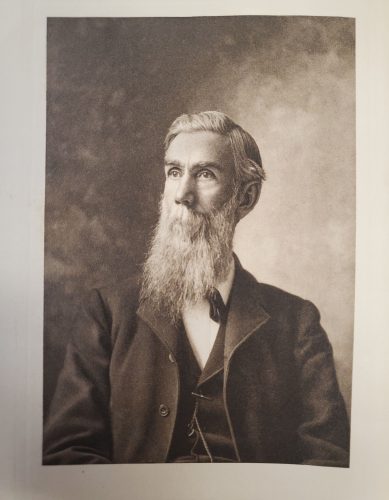
George Alexander Norwood
George Alexander Norwood was a devout member of the Hartsville Baptist Church community beginning in his youth. He was a family-oriented man who explored many careers in order to provide for his family. After leaving Wake Forest College as a young man, Mr. Norwood settled down in his hometown of Hartsville, South Carolina. He was a well-known figure who participated in and eventually led a close-knit farmers’ club. Following the conclusion of the Civil War, Mr. Norwood moved to Effingham, South Carolina where he merchandised and manufactured naval stores. He eventually expanded his business to Charleston, South Carolina before he left once more to engage in the banking business. This banking business would become his family legacy.
George A. Norwood Jr.
George Alexander Norwood’s son, George A. Norwood Jr., followed in his father’s footsteps. After leaving Wake Forest College, he returned to Charleston to assist in the running of the family business. Eventually he moved to Goldsboro, North Carolina, where he established the National Bank of Goldsboro as well as the Goldsboro Savings and Trust Company. He was president of these banks for thirty-five years. In 1924, he helped organize the Tri-State Tobacco Co-op Association. As president he traveled Europe in order to persuade government officials to buy tobacco directly from the Farmers Cooperative. He also served in leadership positions across his many interests, including serving as a founding member of the Goldsboro Public Library and chairman of the Goldsboro School Board. All the while he assisted in developing projects like a brick manufacturing plant and the first gas plant in Goldsboro to power lights for the town. He and his wife, Miss Louise Hart, had eight children together.
Thomas Hart Norwood
George A. Norwood Jr.’s eldest son, Mr. Thomas Hart Norwood, shared his father’s affection for staying busy. He entered Wake Forest College at the age of 15, and he graduated from the University of North Carolina in the class of 1913. From there he took a graduate course in banking at Harvard University, then spent another year in training at the Federal Reserve Bank in Richmond, Virginia. Then he joined his father in the National Bank of Goldsboro in 1915. After several years working as a cashier, he went on to organize the Citizen Building & Loan Association within the National Bank of Goldsboro.
By 1932, the banking system was on the verge of collapse and the country fell into the Great Depression. As a result, Thomas took up a job as a bank examiner and bank examiner reviewer for the Federal Deposit Insurance Corporation (FDIC). He was a bank examiner for New York State for ten years before being transferred to Washington, D.C., where he worked as a bank examiner reviewer for another ten years. He retired after twenty years of service in 1952.
In his retirement, Thomas became interested in gardening. He converted a general building contractor’s four acres and an office into his “Rhododendron Palace” where he planted and cared for hundreds of rhododendrons and azaleas. He spurred the town’s Men’s Gardening Club into action and led beautification projects across the town by planting native holly trees.
Evan Wilkins Norwood
George A. Norwood Jr.’s second-eldest son, Mr. Evan Wilkins Norwood, also shared his father’s affinity for always having something to do. He entered Wake Forest College in 1911, and in the spring of 1912 he planned a trip to England and Europe. This trip included 5 weeks on a bicycle, five weeks on the continent, and four weeks at sea. Notably, he testifies to the fact that the trip was worth more than a year of college to him. After leaving school he took a job at an architect’s office, which inspired him to build his first home for him and his wife, Emma Fedora Wilson. However, it was only two years into the project that he was called back to South Carolina to work as a teller at the Goldsboro National Bank.
Evan didn’t stay in the banking business for even one year. This is because he had always been interested in his church and mission work. He made the trip to the Baptist Foreign Mission Board so that he could volunteer himself and his family to go to China as a Financial Secretary and aide to the many missionaries in China. From there, he packed up his family and necessary belongings and boarded a ship bound for Shanghai. When China was invaded by Japan in 1928, the Norwoods became refugees before they were able to return to the United States many months later. Evan was able to continue his mission efforts about a decade later, but carried out much of his travel alone so as to not endanger his wife and children.
Eventually the family was reunited in the United States when Evan found a job as an auditor of the city of Winston-Salem. He and his wife were still able to carry out mission work in local hospitals and prisons. In his retirement, he planned another European expedition where he would trace the steps he took as a younger man. Content with his life, he was a very active man until his last days.
Charles Stephen Norwood
One of George A. Norwood Jr. and Louise Hart’s eight children, Charles Stephen Norwood lived a fulfilling life. He attended William St. Schools and Wake Forest College before transferring to the University of North Carolina, where he received a B.S. in Banking and Finance in 1927. His first job was at the Bank of Goldsboro, and he was elected the Secretary Treasurer of the Citizens Building and Loan Association in the same month of the bank’s closing in 1931.
Charles eventually became associated with his father-in-law’s real estate business, and Crawford-Norwood Realtors became the new name of the real estate department in 1931. He developed over 20 subdivisions and built over a thousand homes around Goldsboro through the real estate firm. His first marriage was to Miss Mary Crawford, who passed away in 1973. He remarried the widow Mary Corpening, and he continued finding new projects and developing his respective businesses for the rest of his life. Special Collections & Archives houses the family album Charles compiled to remember and immortalize his family’s history and achievements.
4 Comments on ‘ABCs of Special Collections: N is for…’
This is a wonderful initiative, Alayna. Thank you for keeping it rolling! And thanks to Taylor for this interesting and thorough contribution.
This is a very well written and fascinating history of the Norwoods. Thank you for this contribution!
I love collection highlights like these! Thanks to Taylor for sharing!
Thank you for your work on this! Interesting story!