

Unearthing NC Roots of the Revolution
Written by Shannon Bothwell, SCA Volunteer
The search for political self-determination and religious liberty motivated many immigrants to the British North American colonies in the 17th and 18th centuries. While each of the Thirteen Colonies had a unique mixture of cultural, political, and environmental influences, most of the colonies that became the United States experienced events foreshadowing the movement for American independence.
In North Carolina, from the 1760s through the early 1770s the Regulator Movement united small-scale farmers and tradespeople from the inland regions of the state – the “backcountry” now known as the Piedmont and mountains – against perceived abuses by the government officials and large plantation owners based in the coastal plain in the eastern portion of the state. Complaints against Lieutenant-General William Tryon, the crown-appointed governor, revolved around disputes over taxes and over-representation of wealthy elites in government positions – an early version of “no taxation without representation” – along with his efforts to institute the Church of England broadly throughout the state. The Regulator Movement had significant support from evangelical churches which by this time were well established in the state. Herman Husband, a principal leader of the Regulators, was a Quaker and many members of Sandy Creek Baptist Church and associated churches were active in the movement. The movement culminated in Governor Tryon leading the state militia against the gathered Regulators and defeating the rebels decisively in the Battle of Alamance on May 16, 1771. While the movement could be considered a precursor to the American independence movement, the shifting interests and alliances of colonial North Carolina meant that many of the state militia leaders who led the force that defeated the Regulators in 1771 became Patriots and went on to become officers in the Continental Army.
At the same time, while the Anglican Church was the predominant faith in eastern North Carolina during the colonial period, there were also communities of other faiths in these relatively more populous areas. One of the earliest documented Baptist congregations in the state was formed in 1727 by Paul Palmer in present-day Chowan County, and his preaching efforts extended throughout a region north of Albemarle Sound including present-day Perquimans and Pasquotank Counties. The Kehukee Association of Baptist churches was formed around 1769 and included churches from eastern counties such as Warren, Nash, Halifax, Edgecombe, Bertie, Martin, Pitt, and Wilson. These eastern North Carolina Baptists were plainly within the swirl of the political and economic controversies that ultimately led to the American Revolution.
Like most future states, North Carolina had significant populations of both Loyalists and Patriots, and that diversity is demonstrated in the collections at ZSR. Records from the NC Baptist Historical Collection from some of the oldest Baptist churches in North Carolina illustrate this complicated context.
Colonial Baptist Churches of North Carolina
Written by Marcia Phillips, Metadata Specialist
The establishment of local churches in the colonial era in North Carolina indicated the intention of migrating pioneers to put down roots and create permanent communities, with their spiritual needs being of utmost importance.
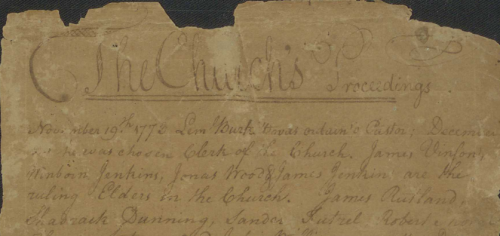
Sandy Run Baptist Church, the oldest church in Bertie County near the coast, was formed in 1750 by a wave of settlers coming down from VA for whom a priority was organizing a church of like faith with Pastor Thomas Pope, later planting at least seven other churches. The original 1772 minutes, in Wake Forest’s Baptist Historical Collection, spelled out ‘The Church’s Proceedings’ with a flourish signaling its importance, similar in appearance to the Declaration of Independence to come.
Cashie Baptist Church was meeting as early as 1770 in Windsor, also in Bertie County, first in private homes in true Baptist tradition and then in a “meeting house” designated exclusively for Baptist worship services. Founding Pastor Jeremiah Durgin, known for his passionate preaching, was granted use of his land by William Virgin “as long as meeting house remains” in a deed dated February 1776, just months prior to the Declaration of Independence. Its minutes from 1790 included slaves as full fledged members, a not uncommon Baptist church practice in North Carolina prior to emancipation.
Representing the missionary efforts of the Great Awakening, Sandy Creek Baptist Church was founded in 1755 by Pastor Shubal Stearns near the present town of Liberty and quickly became the mother church to hundreds of church plants across North Carolina and beyond. Sandy Creek Association is the oldest Baptist association in the North Carolina Baptist Convention. Pastor Stearns, having advocated a peaceful approach to the Regulator Movement, witnessed the flight to safety following the Battle at Alamance of his members, reducing the church membership from 600 to 14. Yet it survived and today its history is manifest by three historic buildings on its remote hilltop.
In the early 1770s as tensions mounted in Colonial North Carolina and protests increased against British control, these churches continued to function as Baptists long had in spite of threatening political circumstances. However, often divided between Loyalists and Patriots, at least one church voted to forgive their independence fighting brethren and allow all to worship without judgment. Most rode out the storm and became some of the oldest churches in the newly formed State of North Carolina.
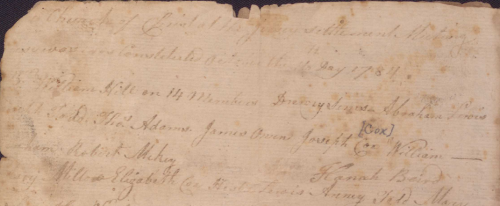
Except when they did not survive. Historic Jersey Baptist Church, organized in 1755 in present day Davidson County, found it impossible to weather the storm. Their first pastor John Gano left to later serve as George Washington’s chaplain in the Continental Army. Jersey Church was dealt a second blow when Deacon Benjamin Merrell was executed after the Battle of Alamance. The church disbanded but its members did not abandon church attendance, crossing the Yadkin River to worship at the Baptist meeting house at Fork. In 1784 Jersey Baptist Church reorganized with its first new minutes stating the names of 13 brethren and 2 sisters as founding members and survivors of a revolution. Their purchase of 2 gallons of wine expressed their commitment to many communions to come.
These early fragile documents in the Wake Forest University Baptist Historical Collection speak to commitment, individual church autonomy and freedom to worship – all qualities that made them a good fit in the new nation being formed.
Transcribing the History of North Carolina Baptists in From the Page
Written by Ashelee Gerald Hill, Access and Outreach Archivist
The North Carolina Baptist Historical Collection, also known as the Ethel Taylor Crittenden Collection in Baptist History, serves as a premier repository for church records, organizational minutes, and manuscripts reflecting over 300 years of Baptist faith activity in the state. As one of the most frequently utilized resources within Special Collections & Archives (SCA), it supports hundreds of annual research inquiries from genealogists and historians. The records from colonial-era congregations, such as those discussed in this post, provide essential documentation of daily life and community responses to pivotal historical events during the founding of the United States.
Since 2021, SCA has leveraged From the Page, a crowdsourcing platform that allows volunteers from around the globe to transcribe and index these historic documents. This collaborative effort is vital, as it enables the library to make unique manuscripts searchable and accessible in ways that limited staffing would otherwise prohibit. Volunteers have already completed transcription of early Wake Forest Board of Trustees records and have moved on to selected Baptist church minutes.
Our current progress on Revolutionary and colonial-era records:
- Sandy Creek Baptist Church (1770-1859): Currently 61% transcribed. These minutes document the “mother church” of the Separate Baptist movement.
- Eaton’s Baptist Baptist Church (1772-1787): Now 100% transcribed.
- Women’s Mission Society (1885-1900): 50% transcribed.
- Sandy Run Baptist Church (1773-1821): Currently 64% transcribed. Recent activity includes transcriptions by guest users like Rose H. Bonnell.
- Jersey Baptist Church (1784-1797): Currently 50% transcribed. Volunteers like Janice G have been active in editing and reviewing these pages.
- Cashie Baptist Church (1791-1832): Currently 65% transcribed.
If you wish to help preserve and share this history, we enthusiastically welcome your participation. You can become a volunteer by following these steps:
- Sign up for an account at FromThePage.com.
- Search for “Wake Forest Archives” to find our active projects.
- Select a page to transcribe; we provide help documentation to assist with difficult handwriting or complex table formatting.
We are deeply appreciative of our community of over 60 volunteers who make this work possible. Please feel free to reach out to archives@wfu.edu with any questions as you explore these records.
4 Comments on ‘Faith and Freedom: Exploring the Colonial Baptist Records of North Carolina’
Thanks all, for this excellent blog post, which describes the complexity of our historical Baptist collections!
Congratulations to all for this timely and valuable research and explanation of records for the Revolutionary period.
Thank you for sharing these stories and the great work happening behind the scenes.
So impressed by the work that this team does, and I’m learning so much about our Baptist collections. Thanks for sharing!