
This article was written by Carolyn Rice, Manager of Operations and External Relations for the Wake Forest Historical Museum. It was originally written for and published in Circa Magazine.
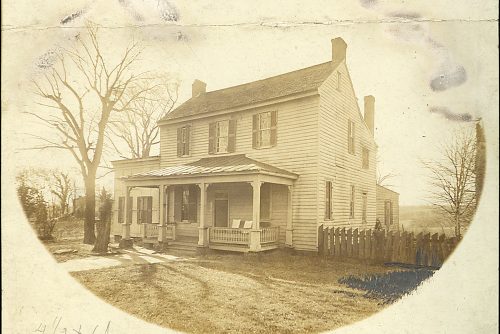
The Calvin Jones House is the oldest surviving building in the Wake Forest Local Historic District and a symbol of the town’s origins. Over the course of two centuries, the house has served as a plantation home, a school building, a faculty residence, a student dormitory, and, finally, a museum. The Calvin Jones House serves as an educational resource for learning about the people, events, and institutions that shaped Wake Forest’s history.
In 1821, Calvin Jones purchased a 615-acre plantation he named “Wake Forest.” On this plantation, the main house stood about a half-mile south of its current site, on what is now the Southeastern Baptist Theological Seminary (SEBTS) campus. Through his marriage to Temperance Boddie Williams, a widow from a prominent family in Franklin County, Calvin Jones gained considerable wealth, including over 20 enslaved people. The couple raised five children: Columbus, Montezuma, William Calvin, Octavia Rowena, and Paul Tudor. In 1832, after selling the property to the Baptist State Convention of North Carolina, the Jones family and the people they enslaved relocated to Hardeman County, Tennessee.
Founded in 1830, the North Carolina Baptist State Convention aimed to educate ministers and support missionaries. The convention hired Samuel Wait to raise funds and prepare the former Jones plantation for a school to train future Baptist leaders. Wait became the first principal of the Wake Forest Institute in 1834 and lived in the Jones’s former home with his wife, Sally, and their daughter Ann Eliza. Students lived in cabins built by enslaved laborers and attended chapel and lectures in the carriage house. In 1839, the college rechartered as Wake Forest College.
In 1842, Wake Forest College trustees sold the Calvin Jones House and 94 acres to Professor John B. White for $400. White moved the house about 100 yards west and, like many faculty families, rented rooms to students. Five enslaved people lived with the Whites at the Calvin Jones House: Amy and Anthony Alston, their daughter Hester, and Ross and Riny. White later served as President of Wake Forest College from 1848 to 1853.
After accepting a position at a girls’ seminary in Brownsville, Tennessee, White sold the house in 1853 to Professor William Thomas Walters for $2,000. The Walters family used the home as their private residence and continued the tradition of renting rooms to students. After Walters died in 1876, his second wife, Isabella Olivia Wingate, and their children continued to reside in the house until at least 1880. In 1916, the family sold the property back to the college for $21,000. The Calvin Jones House then served as a men’s dormitory until the college relocated to Winston-Salem in 1956.
As Wake Forest College prepared to move to Winston-Salem, concern grew for the future of the Calvin Jones House. Annie Gill Harris led preservation efforts, first petitioning Wake Forest College in 1942 and later appealing to SEBTS President Dr. Sydnor L. Stealey, after the seminary acquired the campus in 1956. When plans emerged to demolish the house for a new cafeteria, Harris reminded Dr. Stealey of the house’s historical significance. Dr. Stealey proposed moving the house and creating a historic house museum. Wake Forest College supported their efforts by donating four acres of land for a permanent site. The house was moved to 414 North Main Street in November 1956 and opened to the public as a museum in 1979.
Wake Forest Historical Museum is developing a new interpretive plan for the Dr. Calvin Jones House to make it an inclusive, accessible, and community-focused resource. As part of this effort, they now offer self-guided tours through a web-based app, available Tuesday through Sunday, that lets visitors explore the house at their own pace using any mobile device (no download required). Staff-led guided tours are offered Friday, Saturday, and Sunday at 2:00 PM. All tours are free and open to the public.
3 Comments on ‘The Original Building of the Wake Forest College’
Thanks, Carolyn, for sharing about the history of the Calvin Jones house!
Congratulations for a timely and informative Wake Forest College history reminder.
All of this information is so great and helps tell the whole story of Wake Forest-even the name. Thanks for this!