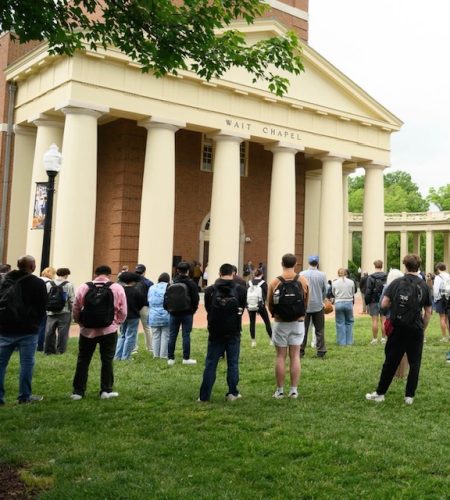
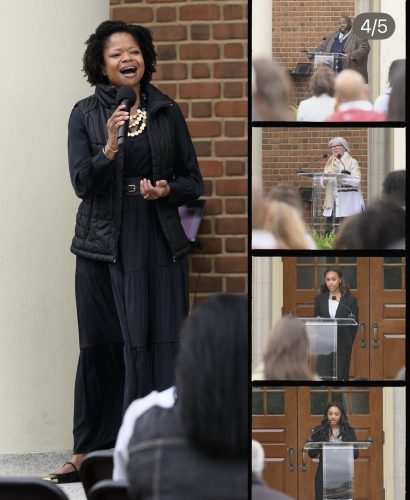
The Wake Forest University Commemoration of the Enslaved was held last week outside of Wait Chapel. The program included prayers, music, a reading of the names of those who were enslaved, and a solemn acknowledgment of those whose names remain unknown.
Now in its eighth year, this meaningful event brought together more than 200 students, staff, faculty, and administrators.
Special thanks go to Jose Villalba and his team for organizing the commemoration, as well as to Barry Davis for recording the program, which is now available online. We also recognized the recent genealogy report on descendants prepared by genealogist Renate Sanders.
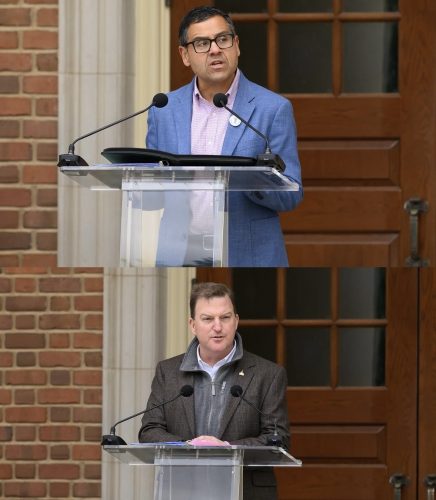
Below, I am sharing remarks from Sean McClure, Coordinator for the Slavery, Race, and Memory Project, along with photographs from the event.
“We gather today not only to remember, but to honor the lives of our enslaved forebearers. As we honor and remember them, let it be our solemn responsibility to rest in the tension of this moment. We join together as the beneficiaries of their sacrifice and lived experience — to speak their names, reclaim their humanity, and shatter the silence that has shaped Wake Forest University from its very beginning.
It is true that Wake Forest has been sustained in some way, shape or form by the lives of enslaved individuals. It grew through their unrecognized labor, and for nearly two centuries, those lives were whispered about only in archives, in ledger books, and in the faint traces of brick and bone. Yet, storytelling — the practice of giving voice to what history sought to erase — has always been the way in which oppressed communities have transformed memory into meaning. Storytelling is both testimony and dream: a way of saying, we were here, and a way of imagining what freedom might yet become.
We now inherit a sacred responsibility. We must tell the story. This work calls us not to solely build monuments of stone, but to become living memorials — people who remember with integrity, who speak with courage, and who act with love. In every recovered name, every reimagined course, every building renamed or repurposed, we are practicing a kind of freedom — one that listens to the ancestors while daring to dream forward.
So, as we begin, let us hold a few truths in tension: Remembrance is not an end, and healing is not passive. Storytelling, in this sense, is an act of repair. It is a call to reimagine institutional culture not as something fixed, but as a living ecosystem — one that grows stronger when it centers the voices once silenced. Wake Forest University functions as an intellectual incubator shaped by the tensions between its historical ties to enslavement and its aspirational commitment to Pro Humanitate. Today as the names of the remembered are read aloud, consider this…With your gifts, intellect, and freedom, how will you honor them? In light of their sacrifice, who and what are Pro Humanitate calling you to become?”
Finally, Baskervill was recently on campus to share the location and final rendering of the WFU Memorial to the Enslaved.
5 Comments on ‘Commemoration of the Enslaved, 2026’
This is a wonderful initiative, Tanya. Thank you so much for all the work you have done to support this important event.
Thank you for sharing this Tanya. I am very glad the university has made this an important issue, and is acknowledging its importance and significance into the future.
Tanya, thank you for sharing the details of this event. I’m glad to see how much it has grown since its inception and where it’s heading with the upcoming Memorial as a visible reminder.
This initiative (including this blog post) is critical to our understanding and acknowledgment of our past and, to borrow Craig’s words, its significance into the future. I am proud to work with you and our thoughtful colleagues across the university.
Thank you for your work with this initiative, Tanya. It was a beautiful commemoration, and Sean’s words were so powerful. Thank you for putting them in print here.