
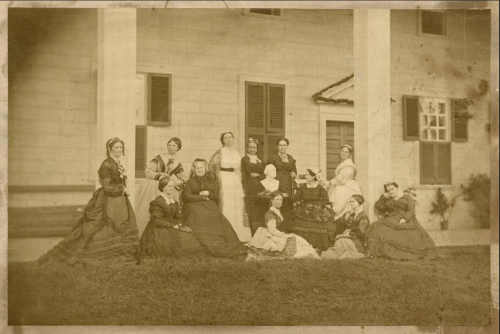
The beloved home of George Washington almost slipped away from American tradition when the death of his great nephew who had inherited the farm and house at Mount Vernon left a desperate widow, Jane Washington, trying to sell the first presidential home in our country’s history. It was in derelict condition and in dire need of funds she did not possess. George Washington was deeply revered as the commander of the Revolutionary War and the nation’s first popularly elected leader but his death had left no direct descendants nor much money. This story showed up in an early Biblical Recorder mention that represents a turning point on a small but significant hillside.
News about the possible sale of Mount Vernon was picked up and included in the November 6, 1847 edition of the Biblical Recorder (in the Baptist Historical Collection of Z. Smith Reynolds Library at Wake Forest University). The newspaper for North Carolina Baptists in its first decade carried not only sermons and church related news but also featured secular news and excerpts of cultural interest that editor Thomas Meredith thought significant. As the only newspaper to which many North Carolinians might have free access (churches routinely subscribed to distribute to their congregants), the biweekly kept country folks informed of events ranging from the War with Mexico on the southern border to the health benefits of tobacco (really). One such news item that Meredith lifted from the New York True Sun mentioned Washington’s homeplace was for sale.
The article, at the bottom of the last page, stated that the United States Congress was considering appropriating $100,000 to purchase the estate with provisions that George and Martha Washington and other family members buried there could never be removed and, if payments were defaulted, it would resort back to the Washington family. This sale and transfer never happened, no doubt because too many other matters were of more pressing concern to Congress. The government of the Commonwealth of Virginia was also approached but to no avail. Meanwhile Mount Vernon continued to deteriorate.
Following Jane’s death in 1855 with no resolution, the estate passed to her son John Washington, (later killed early in the Civil War) who found an unexpected buyer in a single, handicapped woman in South Carolina, Ann Pamela Cunningham. Her mother had first observed the house, with ship masts supporting the sagging front porch roof, and wrote in a letter “If the men of America have seen fit to allow the home of its most respected hero to go to ruin, why can’t the women of America band together to save it?” Cunningham rose to the challenge and personally appealed to key women in all thirty states to raise $200,000 and organized the Mount Vernon Ladies Association. It was not easy to convince donors in northern states to save a southern plantation home that still had slaves but she persisted. Now credited with being the first and longest running preservation organization in the United States, it is still run by women only and has never taken any government funds to restore or preserve Mount Vernon.
Ann Pamela Cunningham was a force of nature. Saving Mount Vernon became her life’s work and her devotion to Washington is best seen in a famous photo of the association in 1870 where a number of “regents” from various states stand or recline on the steps of Mount Vernon, looking rather wearily at the camera, while Cunningham’s face is turned and focused on a bust of Washington. Her dedication knew no limits.
Bad timing, that acquisition in 1859, just before the Civil War broke out when a plantation in northern Virginia on the Potomac River was suddenly vulnerable to battle or capture. However, even in wartime, these formidable women protected it in a daring way. As many troops moving nearby showed great interest in seeing Washington’s home, a rule was enforced that no one could come on the grounds in uniform – of either side. It was spoken of as the only neutral place in the nation during the war and, because most common soldiers did not carry many changes of clothing, one can imagine soldiers scurrying around the presidential grounds in various stages of undress. Amazingly it worked and Mount Vernon survived the war, having become a tourist attraction rather than a battlefield. A divided nation had shown consensus on one thing.
The groundswell of support the ladies’ public appeals created is manifest still today, among the Baptist churches whose early attendees first read the articles about the risk to this national landmark. In the remote community of Olin in Northern Iredell County, a Baptist congregation that had begun to meet near Eupeptic Springs shows in its minutes of 1856 that they chose the name Mount Vernon Baptist Church. In fact, a quick search online reveals currently at least 17 Mount Vernon Baptist Churches in North Carolina and even four in distant Detroit, Michigan. Americans, inspired by a group of women, saved a house and Mount Vernon escaped financial and physical disaster as well as surviving a war, much like its most famous resident.
6 Comments on ‘George Washington’s Mount Vernon, a Women’s Crusade and the Biblical Recorder’
Fascinating history, Marcia! Thanks for sharing it!
This is a great story you extracted from the Biblical Recorder. I love how you do that. I enjoyed reading the Mt. Vernon story- a place we kinda take for granted. Those women made it happen. I lived near West Virginia for a time and learned the George surveyed much of that land, then in Virginia. I believe there are 7 Washington family homes in that area still. George was amazing! Thank you!
Thanks, Marcia, for capturing this side of the Biblical Recorder and the news it shared!
What a fun read and neat connection in the Semiquincentennial year!
So interesting, and I learned a lot! Thank you for sharing, Marcia.
This is a great read, Marcia! There is so much interesting history tucked away in these early Biblical Recorder issues.