
We are continuing our crowdsourced transcription work with From the Page. If you’re new to ZSR, or need a refresher, From the Page is an online platform that takes the difficulty out of transcription work by enabling institutions and organizations to easily crowdsource and collaborate with volunteers on transcription projects. Our first projects began with the transcription of the early records of Wake Forest College, but we have since added projects from the North Carolina Baptist Historical Collection. Recent additions include som records from Cashie Baptist Church in Windsor, North Carolina. Many of our church records include deeds, church minutes, and other routine documentation performed for church gatherings. Since the NC Baptist Historical Collection one of our most frequently used collections for genealogy, having older records transcribed will be helpful for patrons.
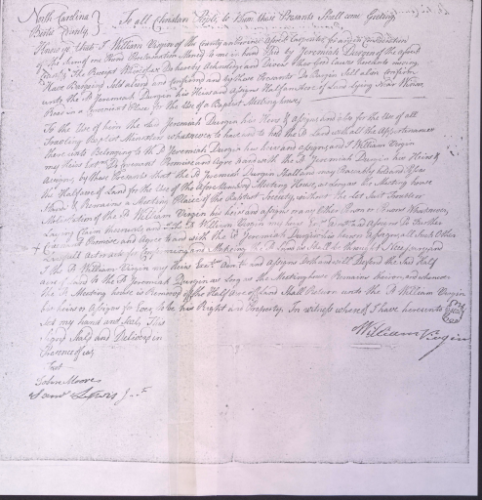
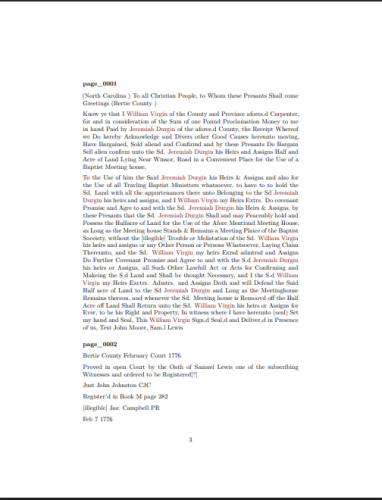
Transcribed text and original deed for Cashie Church, 1776
Transcribed text from original deed for Cashie Church, 1776[/caption]
Currently, there are 33 works that volunteers can work from – so far, 105 collaborators have transcribed 2,885 pages, and of that number only 150 need to be reviewed. I’m currently focusing on reviewing pages from collections that are close to completion. The work of our volunteers ebbs and flows, but their excitement and willingness to help with these projects is invaluable.
Additionally, I want to touch on the potential use of AI to assist with transcription. I’m unsure if Ben and Sara Brumfield, the creators of From the Page, have plans on implementing AI tools on the From the Page platform, but Ben recently shared an example of using Google Gemini to transcribe a record. Gemini was able to utilize contextual clues within the record to provide additional historical insights. It was notably useful for deciphering difficult handwriting compared to script of the same period. The interesting aspect was that Gemini referenced its “knowledge” about actual historical events to decipher and infer information to inform its transcription of the original record. Which raises interesting possibilities for future uses of AI in generating metadata, description and indexing of archival records.
Looking ahead, we continue to value the contributions of our human volunteers, who find the transcription process engaging and rewarding. We currently have at least two collections that are close to being completely transcribed, reviewed, and indexed. In the coming months these should be added to our Digital Collections. Anyone who wishes to assist with transcribing any works from our collections that are currently in From the Page are free to create an account and volunteer. If you are interested in collaborating with us you can become a volunteer by following these steps:
- Sign up at FromThePage.com
- Search “Wake Forest Archives” for active projects.
- Email archives@wfu.edu with any questions.
Please feel free to ask any questions about our ongoing transcription efforts, or our collaboration with From the Page.
8 Comments on ‘From the Page Updates and What’s Ahead’
Thanks, Ashelee! From the Page is such an important and valuable tool for increasing access to our collections. The volunteers who commit their time to transcribing are very much appreciated!
This is such a valuable project Ashelee! Thank you for your work and the work of volunteers to make these records alive.
Thank you for sharing, Ashelee! This is such a great initiative. It’s also interesting to hear how these tools can assist improve and expand access to our special collections.
Thank you for this excellent update, Ashelee! It is great to see the progress we’ve made with From the Page, continuing to value the people who enjoy volunteering their time to engage with our collections while making our collections more accessible in the process.
Thanks for this informative update!
Thank you for the updates on this wonderful project, Ashelee! And thank you to all of our From the Page volunteers for your time and energy. Transcription is so important for preserving our primary sources. I’m intrigued about using Gemini as a tool to reference historical context and decipher difficult handwriting. That might pique the interest of younger volunteers in the future!
Historians and other scholars/students will certainly benefit from this timely and important work. Congratulations.
Great work, Ashelee! Thank you for sharing and promoting this tool to improve access to our collections.