
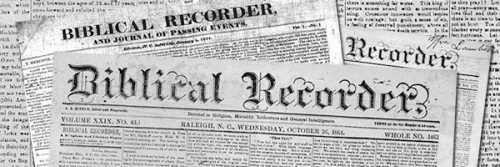
The Biblical Recorder, the newspaper of the Baptist State Convention of North Carolina since 1833, provided in its early years, in addition to printed copies of sermons and other news of general interest, the platform for many intense debates in print on matters of theology and Biblical interpretation of other issues. One particular issue loomed large in the 1830s, 1840s and 1850s – slavery. It was not only the pressing political issue of the day but one on the consciences of good Baptists.
Editor Thomas Meredith included in the newspapers’ front page articles reports on abolitionist groups as well as articles with the admonition for slaveowners to provide religious education for one’s slaves. Second page letters to the editor raised questions about Biblical references to and teachings on slave owning, to which Meredith was never reluctant to respond. It can appear hard to determine his personal conclusion in this balanced approach except for one undeniable fact. Although he never revealed it in the Biblical Recorder that he produced from 1833 up until his death in 1850, Editor Thomas Meredith personally owned slaves.
Meredith was a northerner by birth and upbringing in Doylestown, Pennsylvania but came to North Carolina as a missionary, married a southern girl named Georgia (whose family may have been the source of the slaves but that is unclear) and pastored several churches in North Carolina before creating the newsletter for which he was known. He was also influential in the early days of the state convention and was the first president of the board of trustees of Wake Forest College.
Meredith’s personal convictions on slavery appear ambivalent in print. While he decried the evils of slavery in writings in early editions, he also wrote that he could find no scripture prohibiting slavery. It seems he ultimately sided with his adopted community on the matter of owning slaves; indeed he wrote and circulated separately a pamphlet in 1847 defending slave owning in the South. One editorial debate in the February 24, 1836 Biblical Recorder drew a comparison to the New Testament epistle by Paul to Philemon, returning and encouraging forgiveness for his runaway slave Onesimus; it asked the powerful question whether owning slaves was a sin against God – the answer was a telling “yes…but” The economic ramifications of manumission stymied the landowners in North Carolina churches and provided a hurdle they could not overcome. The Southern Baptist Convention was born in 1845 as northern and southern brethren became denominationally divided, primarily over slavery.
The conflict over slavery was most clearly represented at the headquarters of the Biblical Recorder, for the first few decades a family business for editor and publisher Thomas Meredith, one that he struggled to financially support. In the early years, when he also pastored, that provided the stability of that income but after relocating to Raleigh to be closer to the action, the newspaper was his sole means of support for his family including wife Georgia and their steadily increasing number of children. He purchased a farm to live on and built an outbuilding to house a used printing press he had acquired and produced the newspaper in his own backyard.
Even as his financial need for more paid subscriptions was often emphasized in the newspaper (he even offered it for sale briefly once), Thomas Meredith also struggled with health issues that often incapacitated him. He died in 1850 at the age of 55, leaving a wife, four daughters and two sons, including his older son Marcus, whose name immediately appeared as publisher while Meredith’s pastor at the Baptist Church in Raleigh, Thomas Tobey, emerges in the masthead as editor for a brief stint. The truth behind this staging was that Thomas’ widow Georgia and son Marcus struggled to keep the family business going (a plea to not quit subscribing in the December 17, 1852 edition because it would “injure sister Meredith…toiling to publish the paper as a means of support”) for a few more years before selling it and moving out of state.
Daniel Fountain, who teaches history at Meredith College, has done much research into the private life of Thomas Meredith, including finding the names of several family slaves – Jacob, Lavinia and Nancy. He has also uncovered a deed of sale of slave(s) to cover a debt by Meredith in 1842 (perhaps a business debt related to the newspaper) as well as an undated letter that blames the abolitionists in strong language (“vicious interference”) for the deteriorating relationship between southern owners and their slaves. Fountain concludes Meredith was definitely pro-slavery.
This financial struggle to continue the printing of the Biblical Recorder, combined with the knowledge that the family owned as many as eleven slaves and still had four at the time of Thomas’ death (and not freed in his will), gives rise to the question of whether slaves were involved in the physical work of producing the Biblical Recorder, during his lifetime and after. Family accounts indicate even before his death that Georgia and her daughters were doing the hard work of the printing, handling heavy bundles of paper and the cumbersome machinery of a printing press of that era. If a middle aged woman and teenage daughters were of necessity doing this physical labor, is it not likely that the slaves, including two men ages 22 and 26, were also assisting? Would that not make more sense in financial constraints than hiring assistants if one already owned slaves? (The newspaper often advertised for apprentices and a Wilmington paper reported the imprisonment of one of his but these seem fleeting.) The 1850 census (in the year Thomas Meredith died) lists four slaves but the agricultural census does not state any productivity of that nature on the farm. Were the slaves only household help that would not have been included in the household business when needed?
Sadly, the original papers that might have held the answer seem to no longer exist. A letter from Meredith’s daughter Claudia Tolson appeared in the August 25, 1886 edition of the Biblical Recorder and, in a response to a question about Meredith’s personal papers, states that they were boxed up together at Meredith’s request and stored in the printing office but destroyed in a fire a few years later so unlikely anything other than family memories could shed more light. Research into this continues with a few descendants of Thomas and Georgia Meredith.
While no documentation has yet emerged that definitively supports this conclusion, logic indicates it is likely that slave labor physically contributed to the printing and literary impact of the Biblical Recorder. This behind-the -scenes historical fact never managed to emerge in print in the vast collection (6,453 editions in the holdings of the Wake Forest University Special Collections & Archive, available digitally here) of the Biblical Recorder, the largest single group of records in North Carolina Baptist history.
Add Your Comment